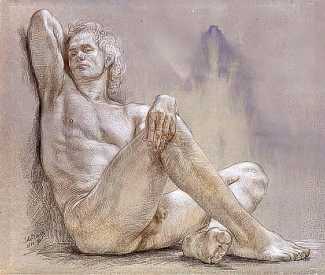
 Drawing remained central to Paul Cadmus’s artistic practice throughout his life. Whether working in graphite, charcoal, coloured pencil or etching, he approached each study with the same disciplined attention that characterised his paintings. These works reveal an artist fascinated by the structure of the human body and by the expressive possibilities of pose, light and line.
Many of the drawings are straightforward studies from life. His models recline, stretch, sleep, dance or simply rest, their bodies observed with extraordinary patience and precision. Cadmus was less interested in dramatic action than in the quiet complexity of the human body. A hand supporting a head, the twist of a torso, the tension of a foot or the curve of a shoulder – all become subjects worthy of prolonged attention.
Although the naked male figure occupies a prominent place, women appear throughout the drawings as well, either alone or alongside male figures. Dancers, seated studies and mirrored compositions reflect Cadmus’s deep interest in anatomy, balance, and the relationship between figures in space. Some drawings remain highly finished while others retain visible construction lines and exploratory marks, revealing the artist thinking through a composition as he worked.
Cadmus’s distinctive coloured drawings occupy a place somewhere between drawing and painting. Built up from layers of coloured pencil on toned paper, they use subtle shifts of warm and cool hues to model flesh with remarkable delicacy. Rather than relying on broad washes of colour, Cadmus built up form through hundreds of individual strokes, creating realistic, believable surfaces with closely observed detail. This technique became one of the defining characteristics of his later work.
The etchings demonstrate a similar command of line. Using dense networks of cross-hatching Cadmus translated the solidity of the human form into black and white without sacrificing volume or warmth. Whether depicting a solitary figure, ballet dancers or figures at the seaside, the prints display the same clarity of observation that runs through all his work.
This selection of Paul Cadmus’s drawings starts with sketches for some of his best-known paintings, including the 1934 The Fleet’s In! and YMCA Locker Room, then continues with monochrome drawings in rough chronological order, finishing with some of his many coloured drawings.