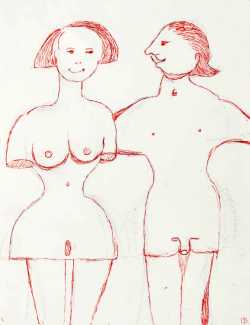
In 1992, during an interviewed with Christiane Meyer-Thoss for the book Louise Bourgeois: Designing for Free Fall, Bourgeois observed that ‘One must differentiate between sex, which is a function, and eroticism, which encompasses so much more.’ She understood the erotic as a web of relationships – desire and rejection, intimacy and isolation, tenderness and violence, vulnerability and power. Her works ask not simply how the body looks, but how it remembers, fears, longs and survives.
Among her earliest images are the remarkable Femme Maison drawings of the 1940s, in which female bodies are topped by houses instead of heads. At once witty and unsettling, they explore the tensions between domestic life, identity and female autonomy. Throughout her career Bourgeois returned to similar transformations, allowing bodies to merge with architecture, animals and abstract forms until conventional distinctions dissolved.
Many of her best-known works deliberately blur accepted ideas of masculinity and femininity. Figures combine male and female characteristics, lovers fuse into single organisms, and breasts, wombs and phallic forms appear as variations of the same visual language. Works such as The Maternal Man, Male and Female, and Father and Son challenge fixed ideas of gender while exploring intimacy, dependence, conflict and transformation.
Family relationships remained central to Bourgeois’ art. Images such as Mother and Child and Ex Libris explore birth, nurture and inheritance without sentimentality. Throughout these works the body becomes a repository of memory, carrying emotional experience from one generation to the next.
The paintings are shown here in chronological order, from The Runaway Girl of 1938 to works created late in Bourgeois’ life.