
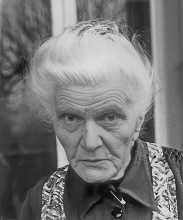
 The Swiss ‘outsider’ artist Aloïse Blanche Corbaz grew up in Lausanne. She completed her schooling in 1906 and trained as a dressmaker, but her great ambition was to become an opera singer. After an early romantic relationship was broken up by her elder sister, she left Switzerland for Germany in 1911, where she worked as a teacher and governess. In Potsdam she became governess in the household of the chaplain to Kaiser Wilhelm II, and developed an intense, imaginary passion for the Emperor. When the first world war forced her return to Switzerland, her religious and pacifist convictions became increasingly exalted. She was admitted to the psychiatric hospital at Cery, near Lausanne, in 1918 and transferred two years later to La Rosière asylum at Gimel, where she remained until her death in 1964.
At Cery, Corbaz began to develop the extraordinary inner world that would dominate her subsequent work. She started drawing and writing secretly at the asylum around 1920, initially using pencil and ink on whatever scraps of paper were available. She later employed coloured pencils, crayons, flower petals, leaves and even toothpaste as sources of colour, while wrapping paper, envelopes, calendars and other discarded materials became her supports. From the late 1930s onwards her work expanded dramatically, eventually covering large sheets and rolls of paper, sometimes several metres long. She also stitched sheets together and frequently worked on both sides.
Her imaginary universe was a vast theatre populated by emperors, queens, saints, opera singers, biblical figures and lovers. Napoleon, Marie-Antoinette, Cleopatra and other historical or legendary characters mingle with invented figures in compositions where identity, costume and symbolism continually shift. At the heart of this world is the female figure, monumental and sensual. Corbaz herself described her role not as artist but as a scribe, recording the visions revealed to her.
Hans Steck, the hospital director, began collecting her work in 1936, and from 1941 the general practitioner Jacqueline Porret-Forel became her devoted advocate, helping to bring her work to the attention of Jean Dubuffet, who included Corbaz among the artists central to his conception of art brut. Her work was exhibited in Paris in 1948 and has since entered major collections internationally.
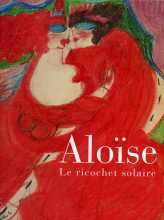 The definitive published resource for Aloïse Corbaz and her work is Aloïse: Le ricochet solaire, published in 2012 by the Musée Cantonale des Beaux-Arts Lausanne in conjunction with the Collection de L’Art Brut and the Fondation Aloïse.
Similar artists
Jean Dubuffet – French originator of art brut who championed Corbaz.
Gérard Gachet – French visionary artist of private, biomorphic body imagery.
Josef Hofer – Austrian art brut artist working from within psychiatric care.
Dorothy Iannone – American painter of ecstatic, autobiographical narrative erotica.
Martina Kügler – German artist whose work also emerged from psychiatric care.
Kalervo Palsa – Finnish outsider painter of dark sexual and existential subjects.
Friedrich Schröder-Sonnenstern – German outsider artist of fantastical grotesque scenes.
Example illustration


