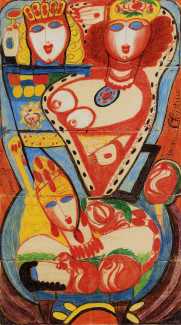
Aloïse Corbaz’s drawings inhabit a world in which desire generates its own reality. Her women are voluptuous, monumental and strangely self-contained, with enormous breasts, long pale bodies, flowing hair and heavily made-up eyes. Around them gather lovers, soldiers, emperors, queens, flowers and birds, all caught up in a drama of seduction, adoration and transformation.
Corbaz did not create her drawings from the observed world. She constructed her own interior one, drawing on opera, history, religion, mythology, and the elaborate theatre of her own imagination. Napoleon, Cleopatra, Marie-Antoinette and operatic heroines appear alongside invented figures, whose identities combine person, costume and symbol, so that a woman can be queen, lover, goddess and theatrical performer all at once. The effect is less that of a narrative being illustrated than of one image provoking another, a sort of visual chain reaction.
This is the significance of ‘le ricochet solaire’ – the solar ricochet – the phrase Corbaz used to describe the singular mechanism of her imaginative universe. Her images seem to rebound from one another, multiplying across the surface until there is scarcely an empty space left. Jacqueline Porret-Forel, whose catalogue raisonné and catalogue texts, written with Céline Muzelle, accompanied the 2012 Corbaz exhibitions in Lausanne, describes a vast reservoir of subconscious imagery connected through unexpected associations of forms, places and sounds.
Colour intensifies this sense of abundance. Crayon and coloured pencil are worked insistently into the paper, with bodies, costumes, hair, jewels and flowers all part of the same pulsating decorative field. The eroticism is inseparable from the ornament – breasts become flowers, flowers become bodies, and lovers dissolve into the lavish costumes and settings that surround them. Sometimes she used scraps of paper like Christmas cards and fruit wrappers to incorporate into her work, suggesting connections between her drawing and the wider world.
There is something wonderfully unapologetic about Corbaz’s women. They are not passive objects within her fantasy, rather they are the power that animates the drawings, their exaggerated bodies, elaborate dress and encounters with lovers creating the worlds around them.