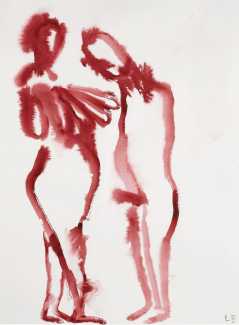
 The Family is among Louise Bourgeois’ final works, bringing together many of the concerns that had occupied her throughout a lifetime of making art. A series of small gouaches on paper, the paintings return to the subjects of sexuality, parenthood, birth, dependence and memory, not as separate experiences but as inseparable aspects of family life.
The figures, painted in shades of crimson, emerge from and dissolve into pools of blood-like pigment. Bourgeois allowed the wet gouache to spread and bleed across the paper, so that bodies appear unstable and continually changing. Limbs merge, faces disappear, and individual identities dissolve into shared forms. Figures are joined by sweeping lines and soft-edged stains that suggest tight physicality and emotional entanglement, imagery which is at once deeply erotic and profoundly maternal, presenting shared intimacy as a web of attachment, vulnerability and responsibility.
These paintings refuse sentimental ideas of the family. Affection and dependence exist alongside anxiety, struggle and the loss of individual identity. Bourgeois understood family as something that binds generations together emotionally as much as biologically, each life shaped by those that came before it. As she wrote of the series, ‘I have the frame of reference of my father and mother, and that of my own experience. I have the frame of reference of my children. And the three are stuck together.’