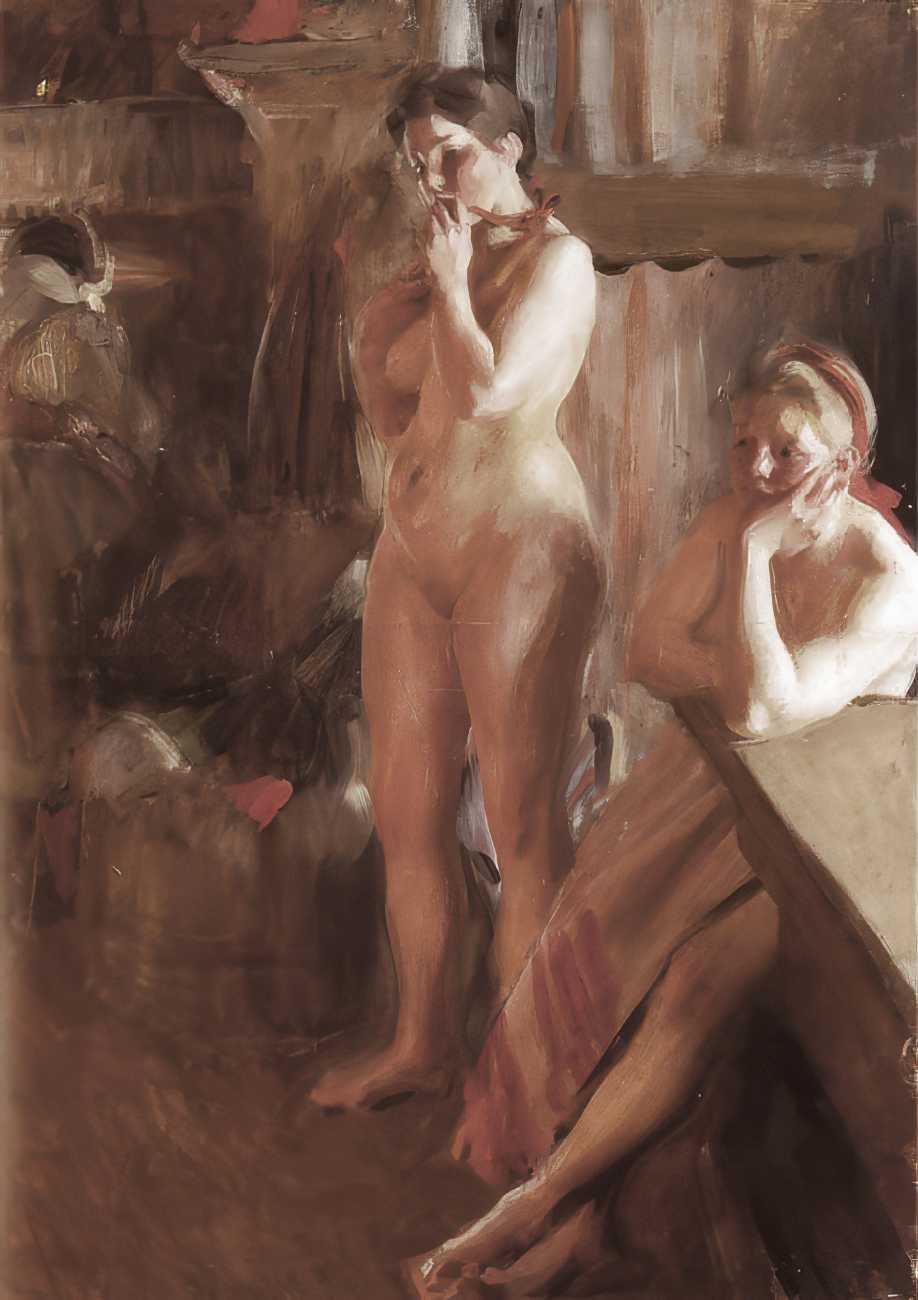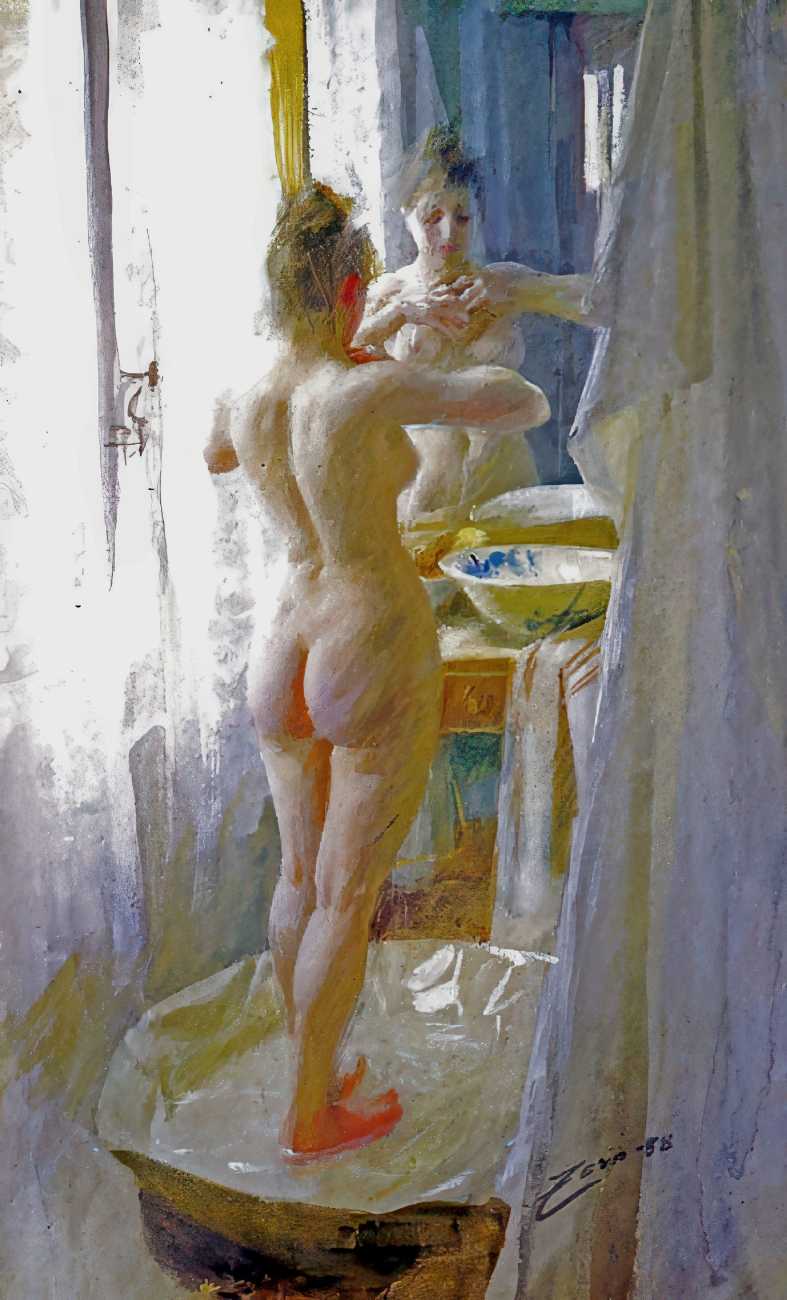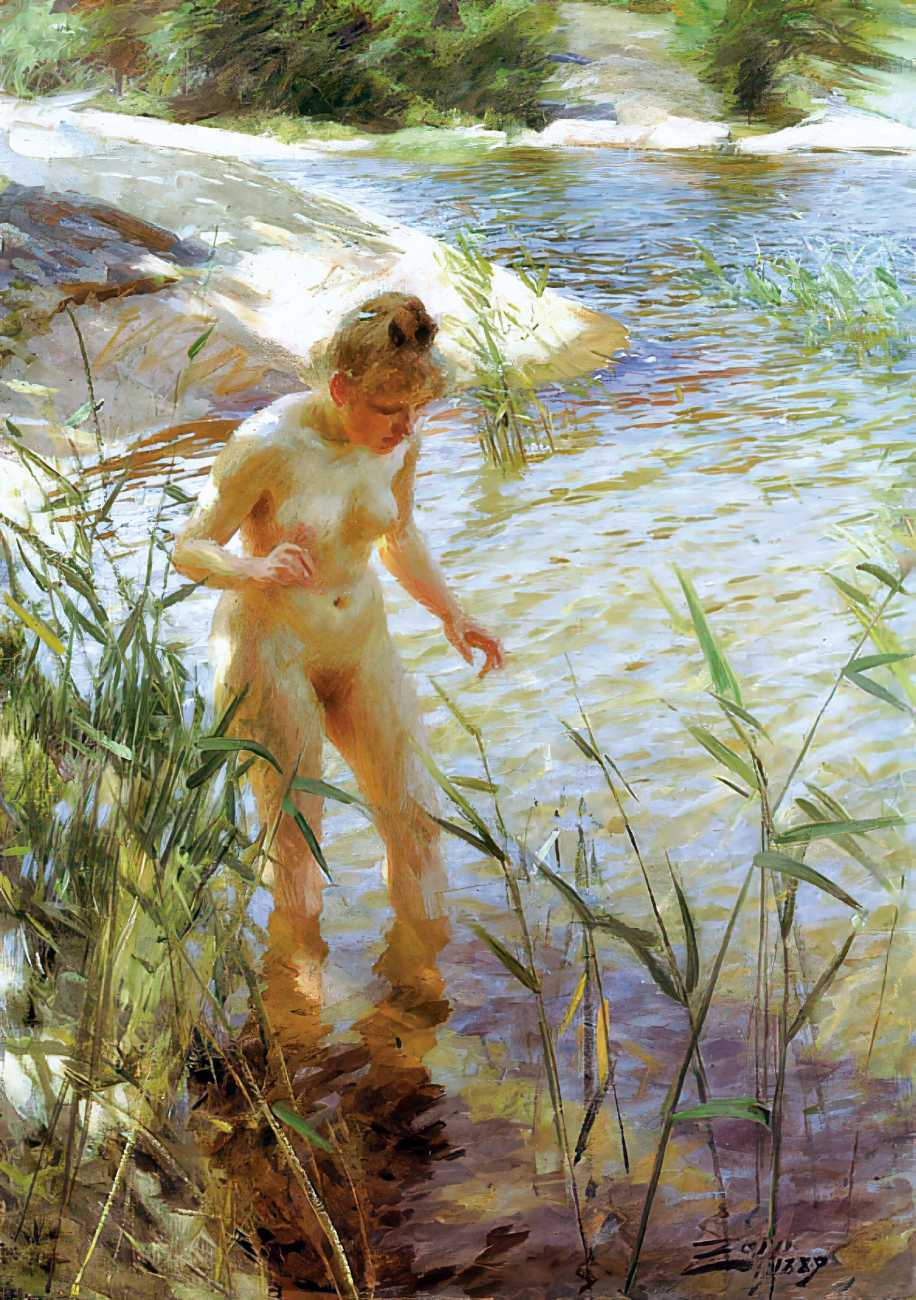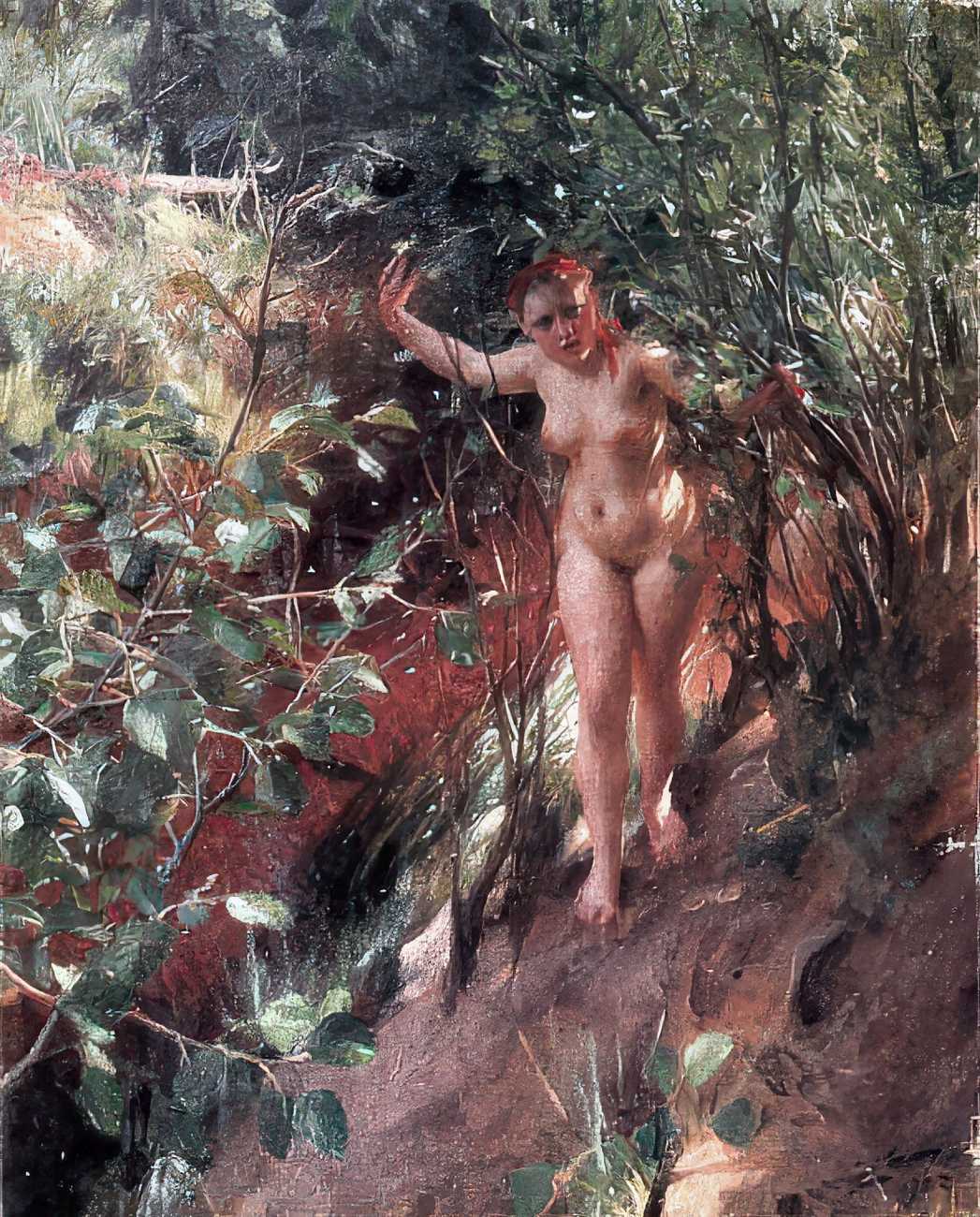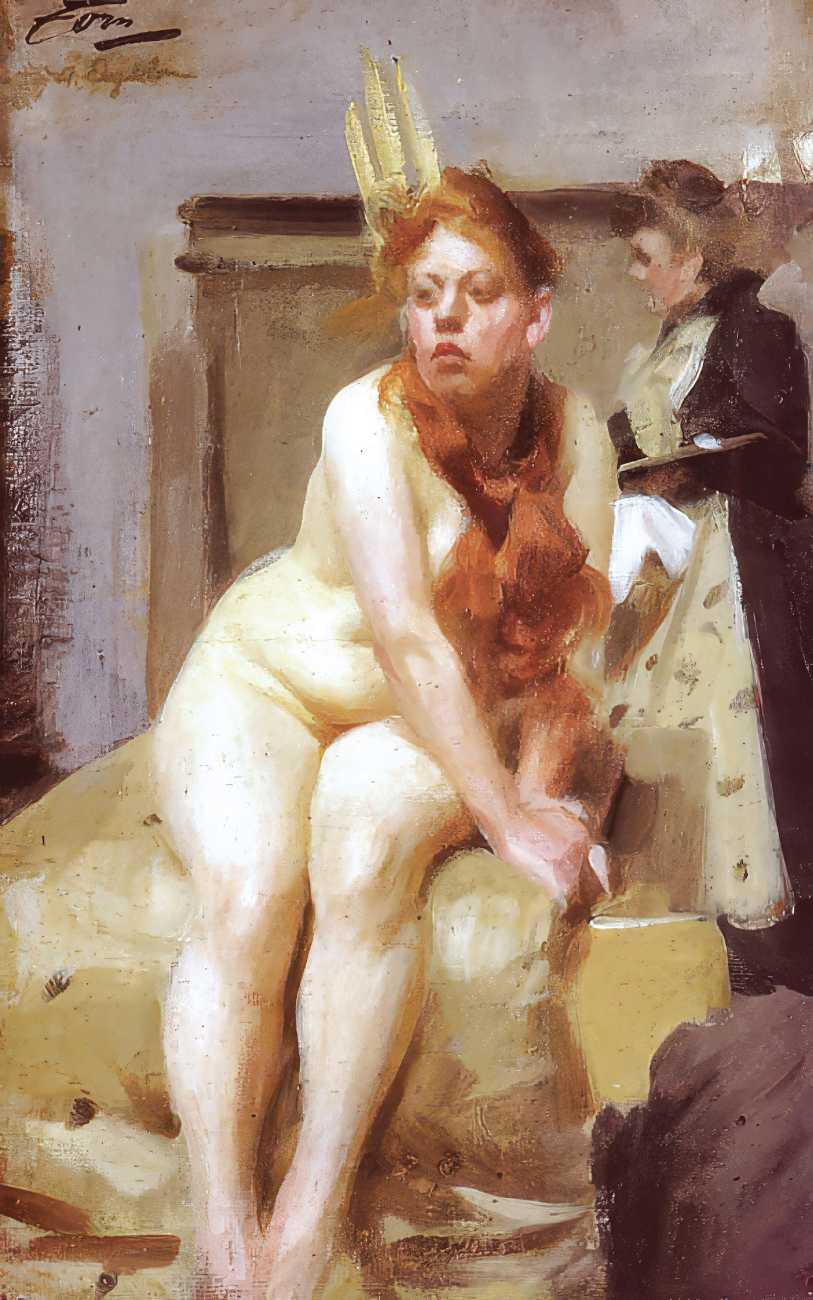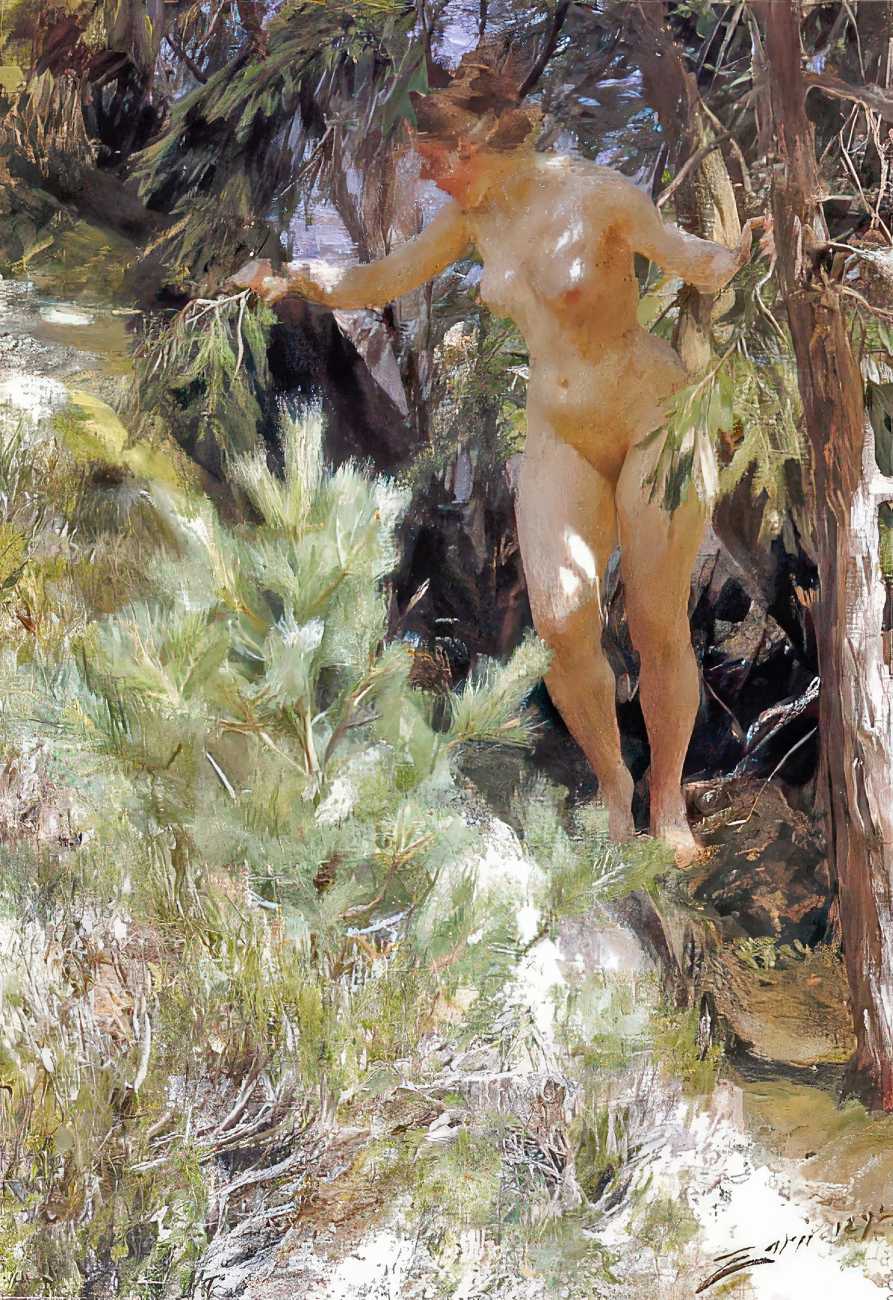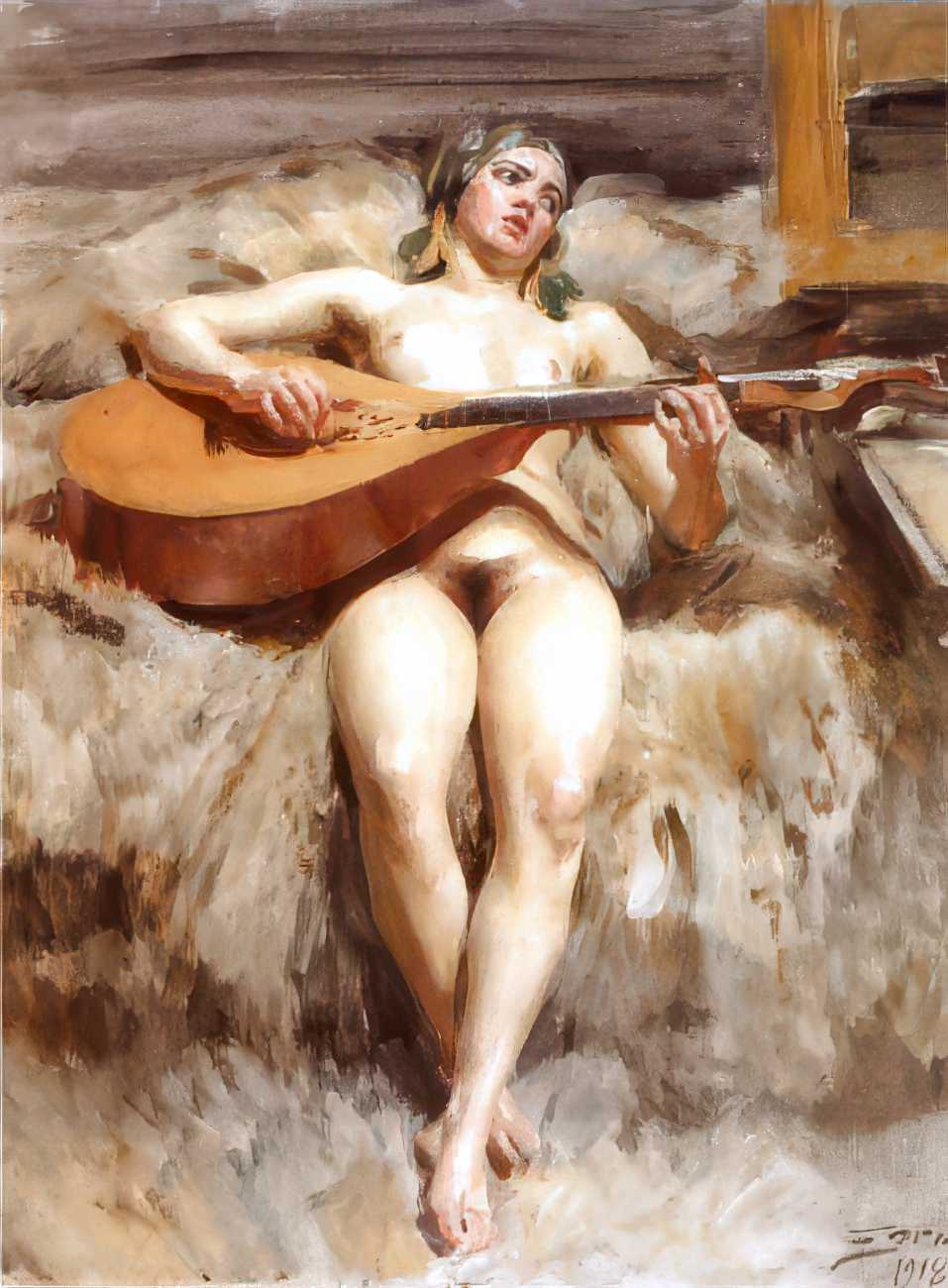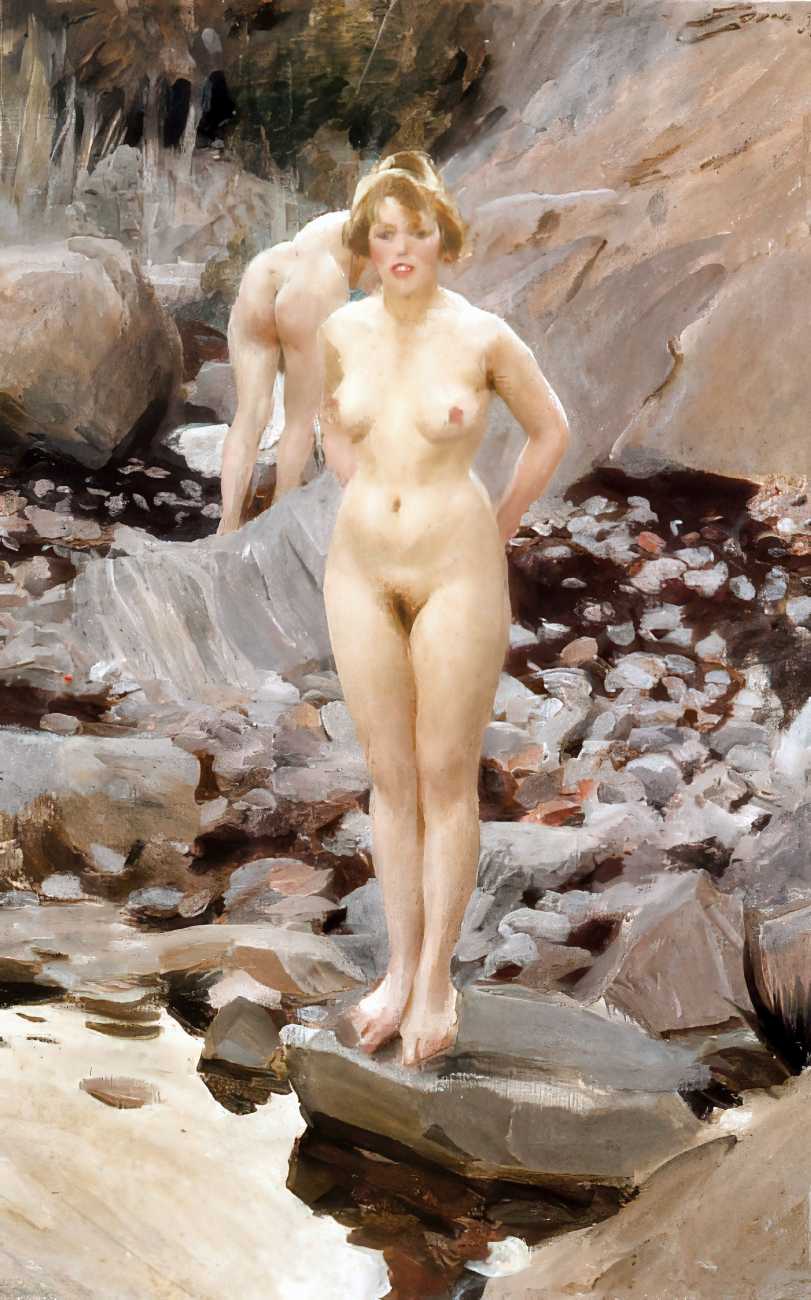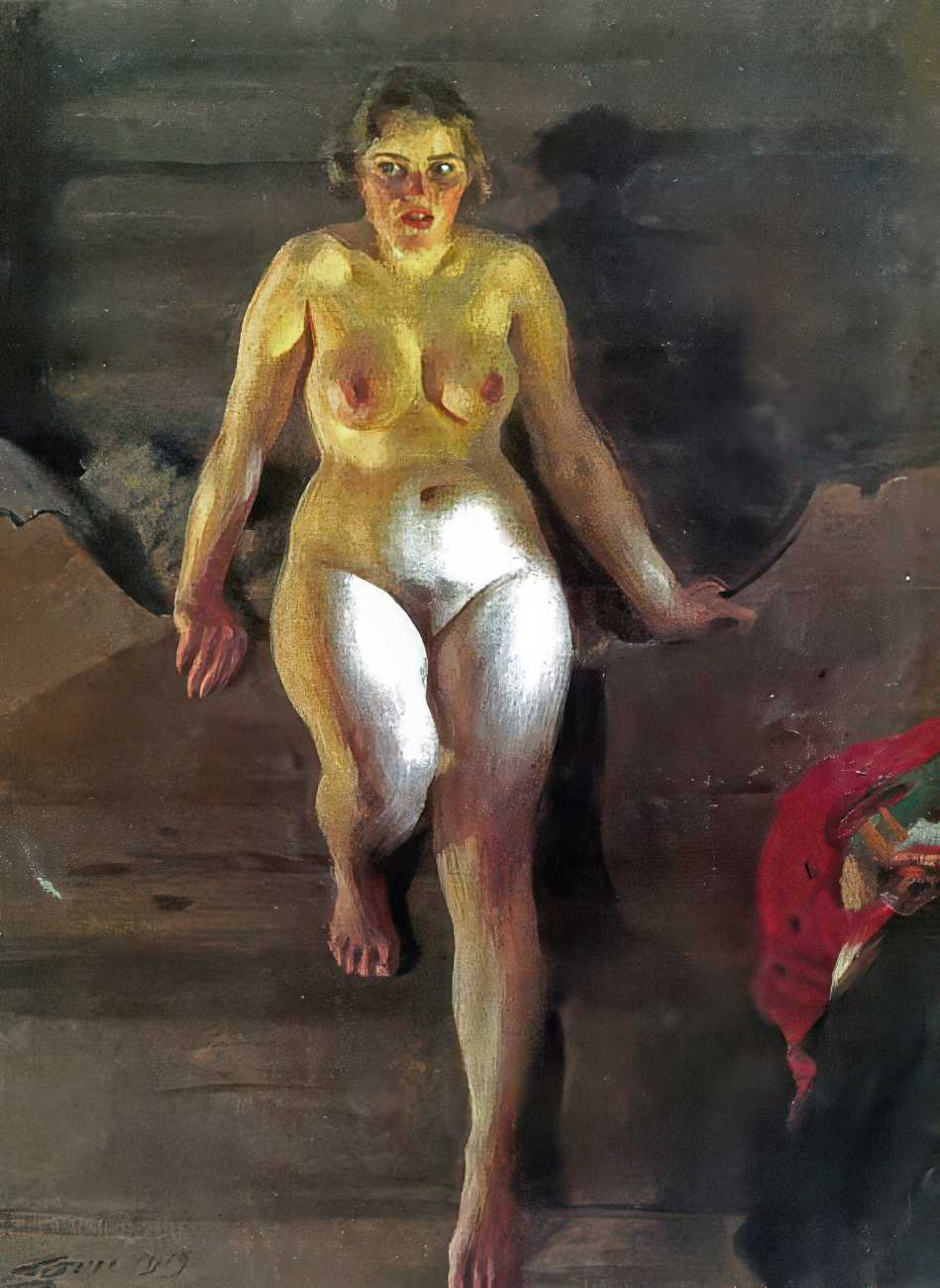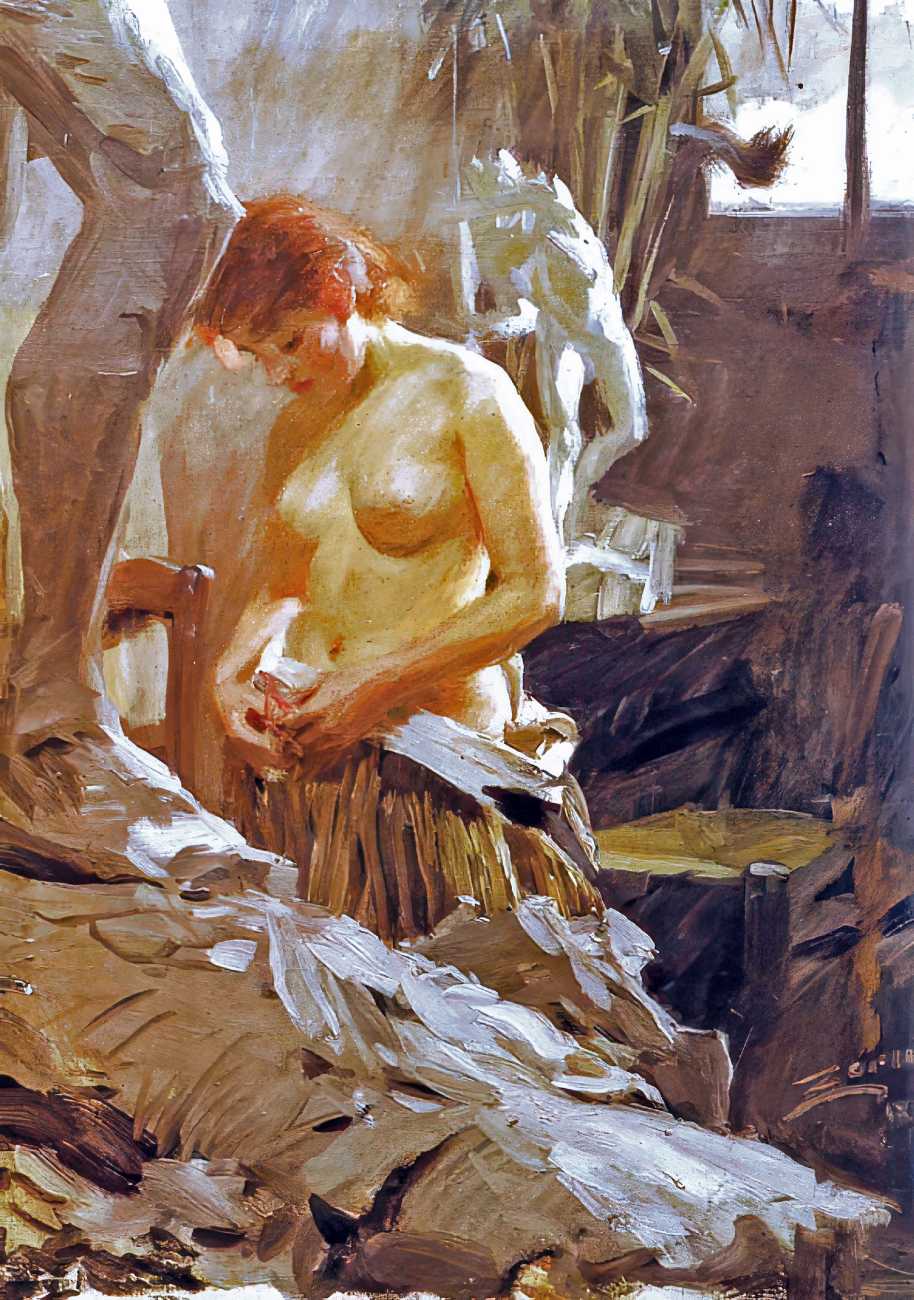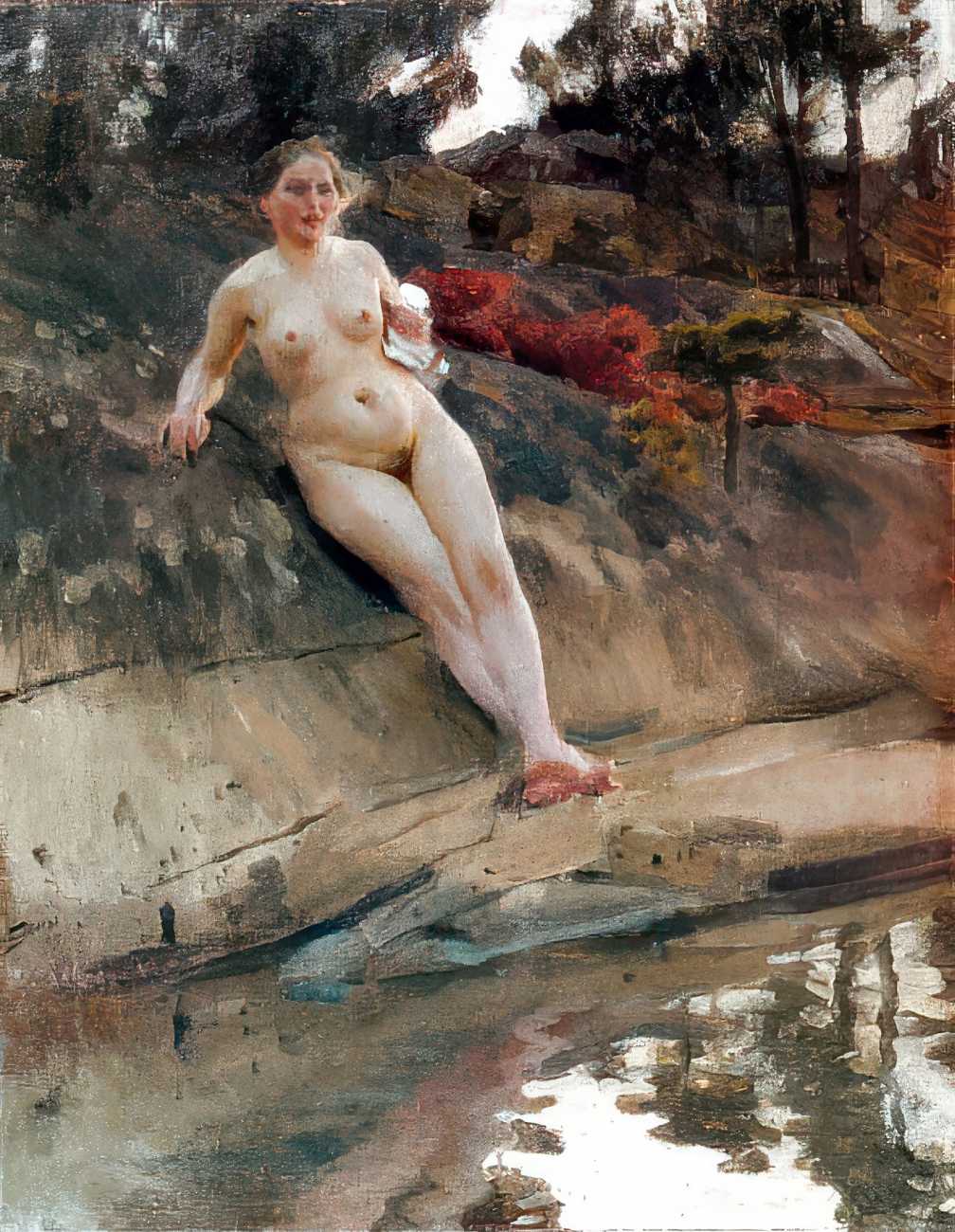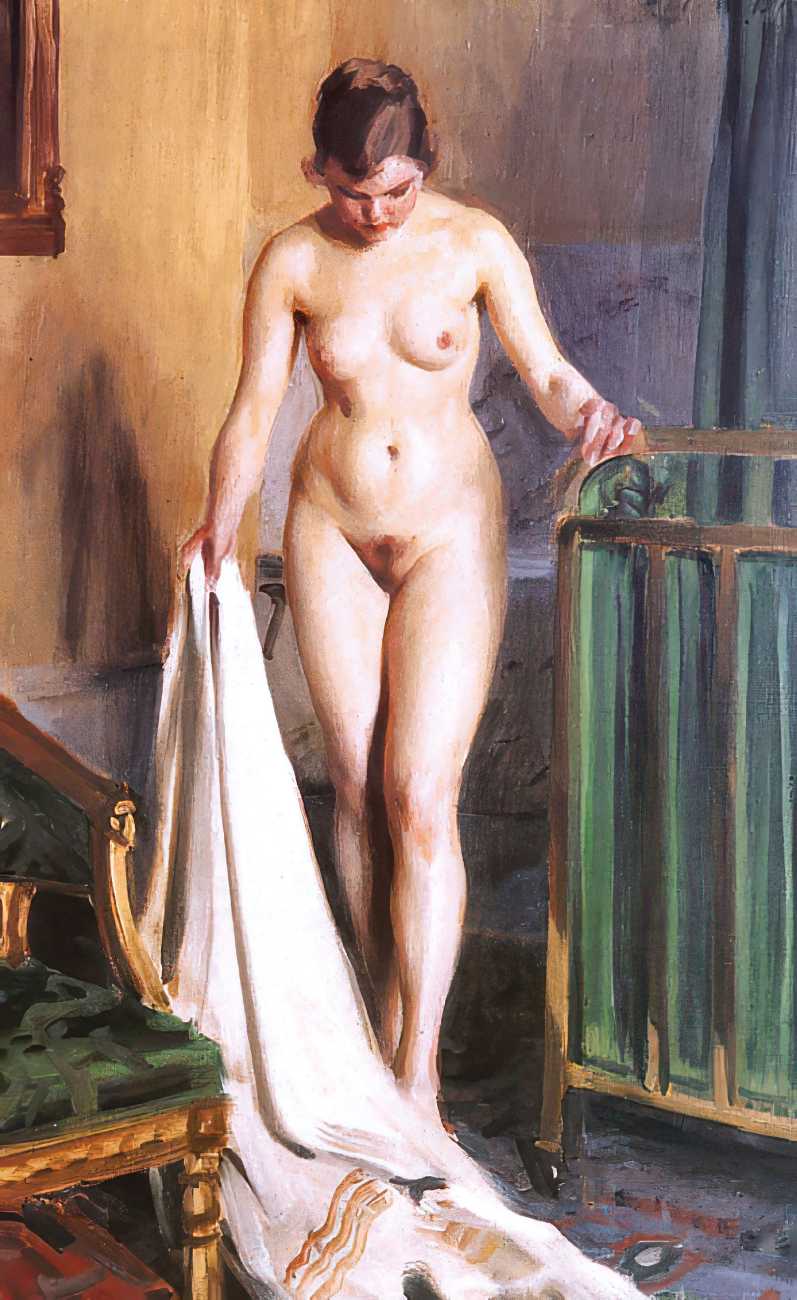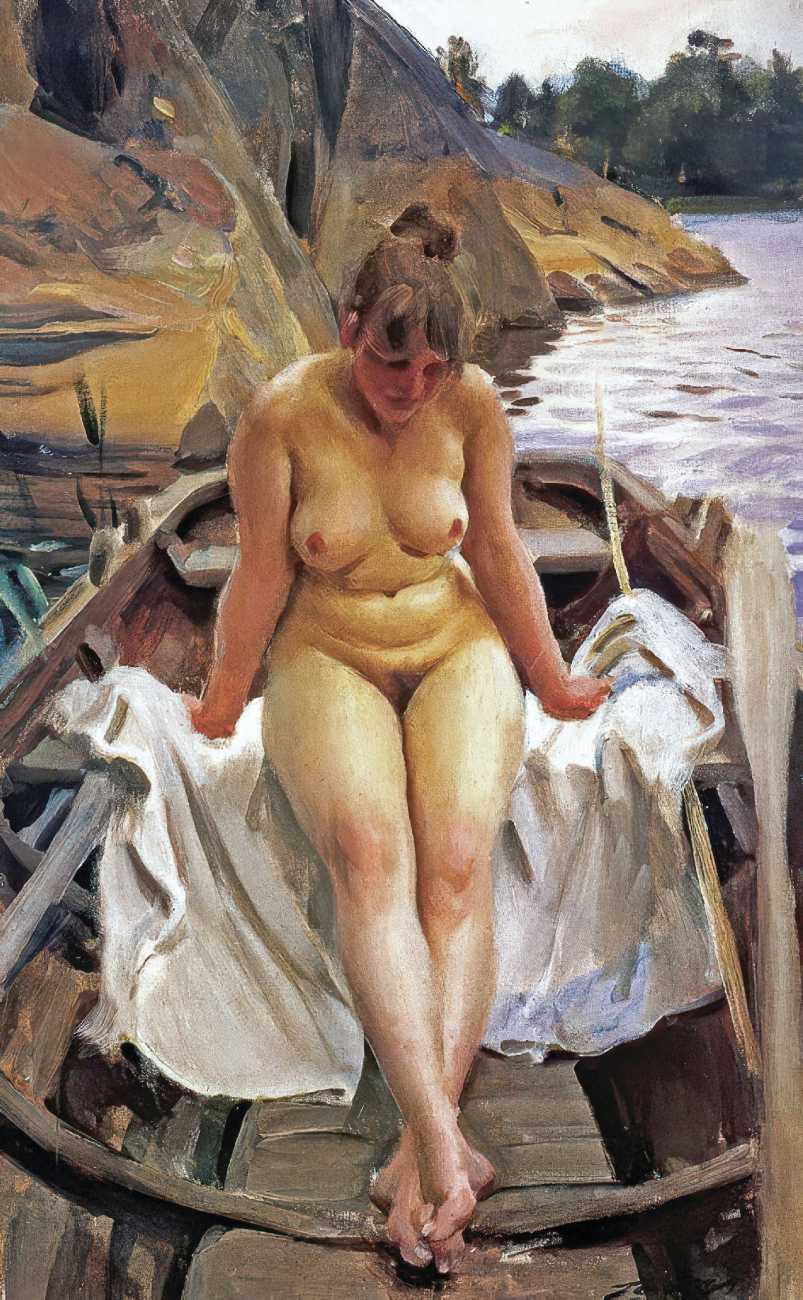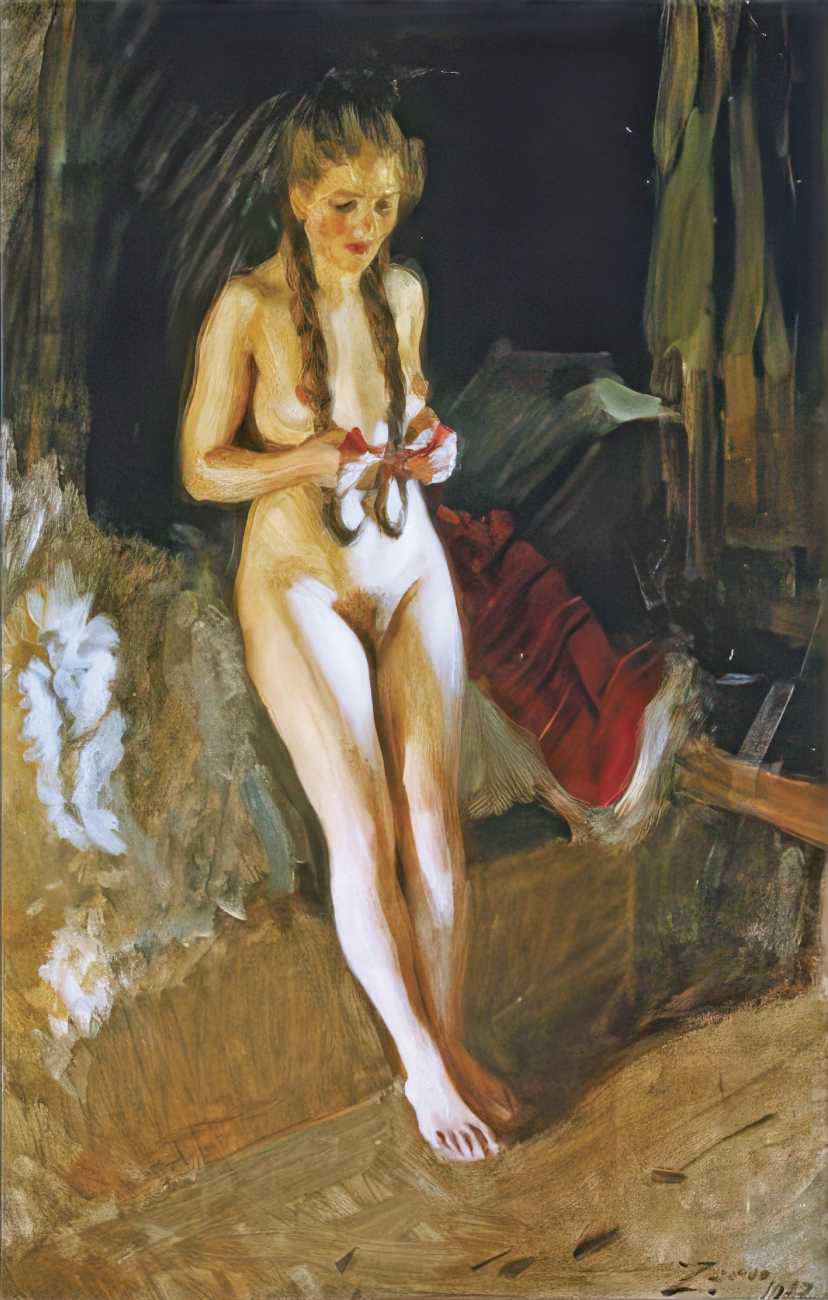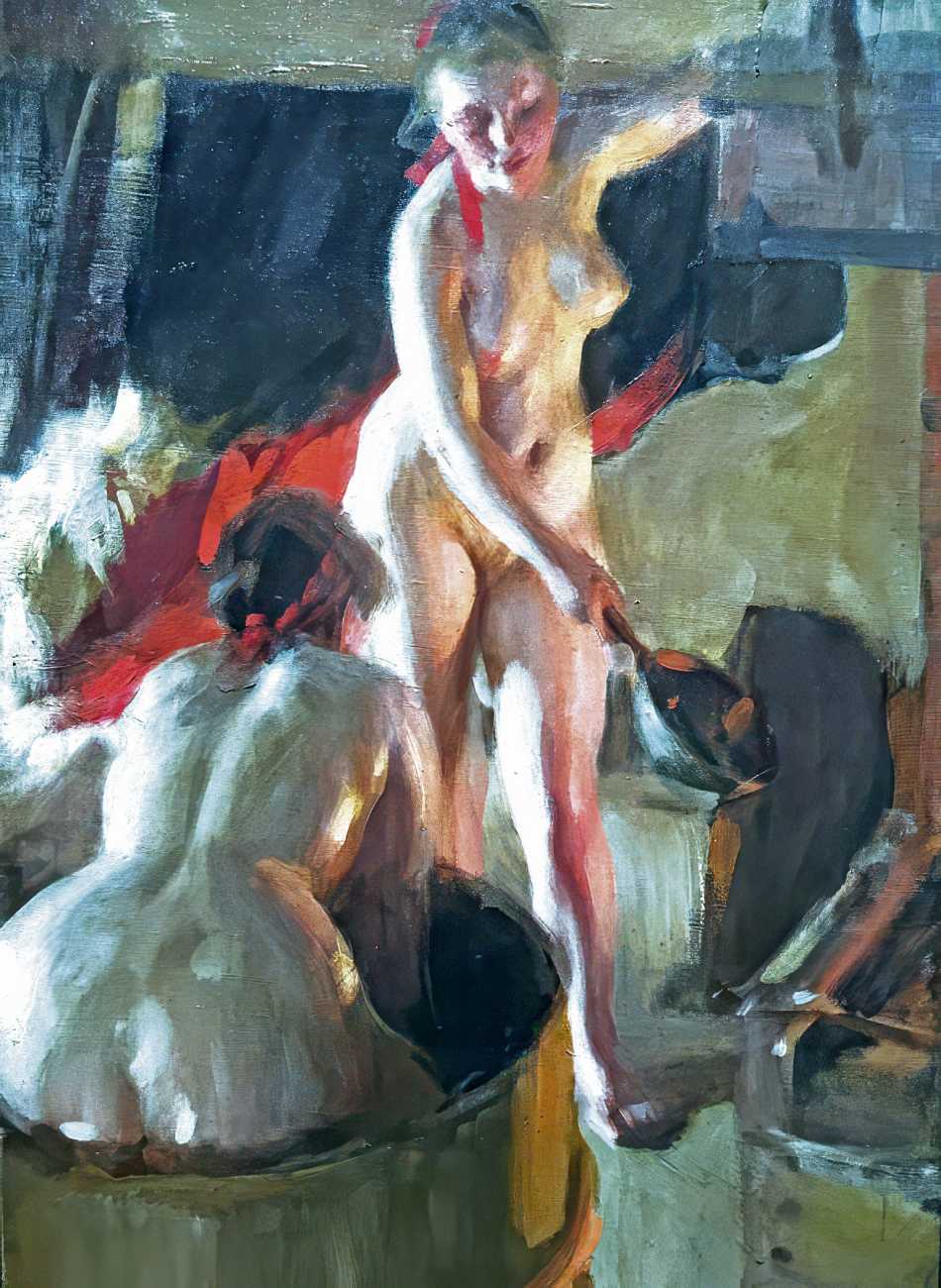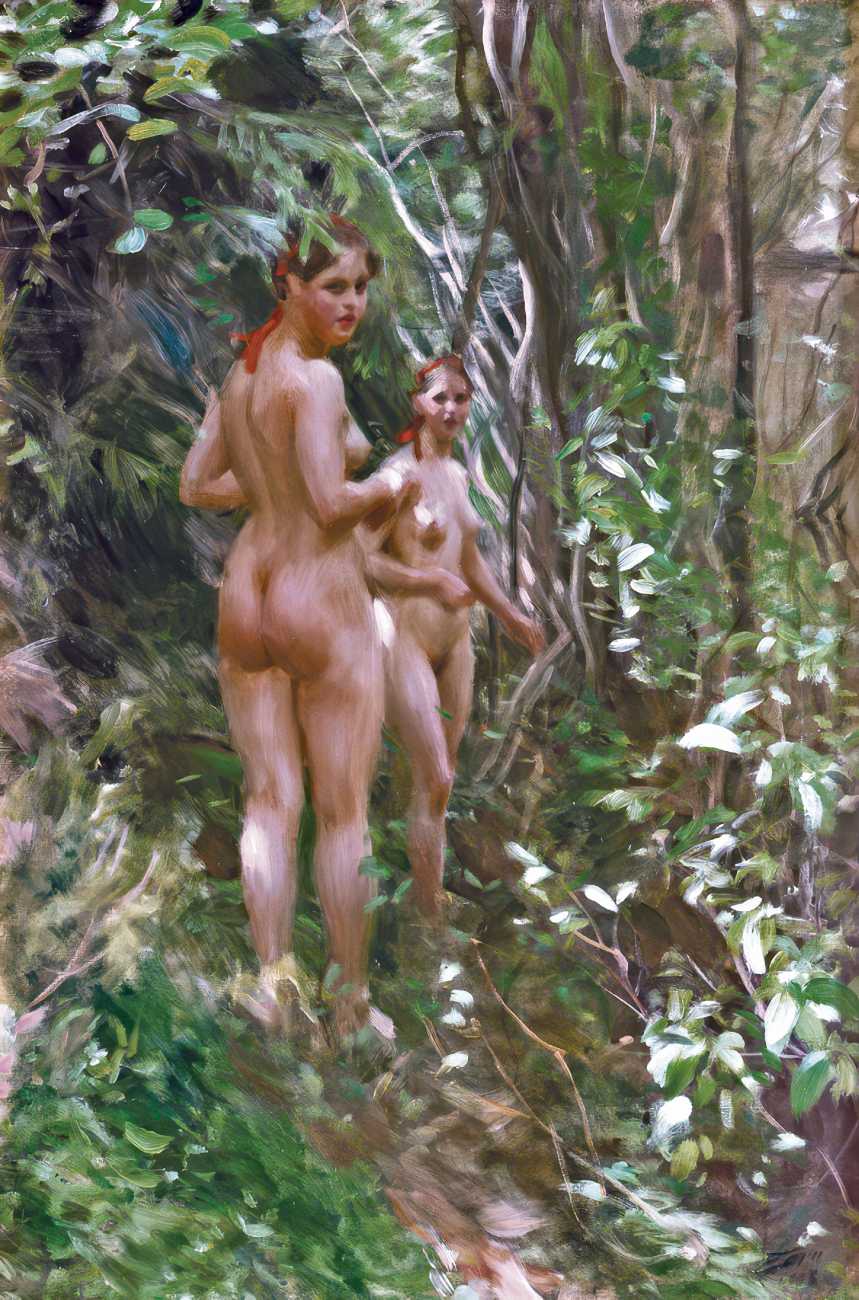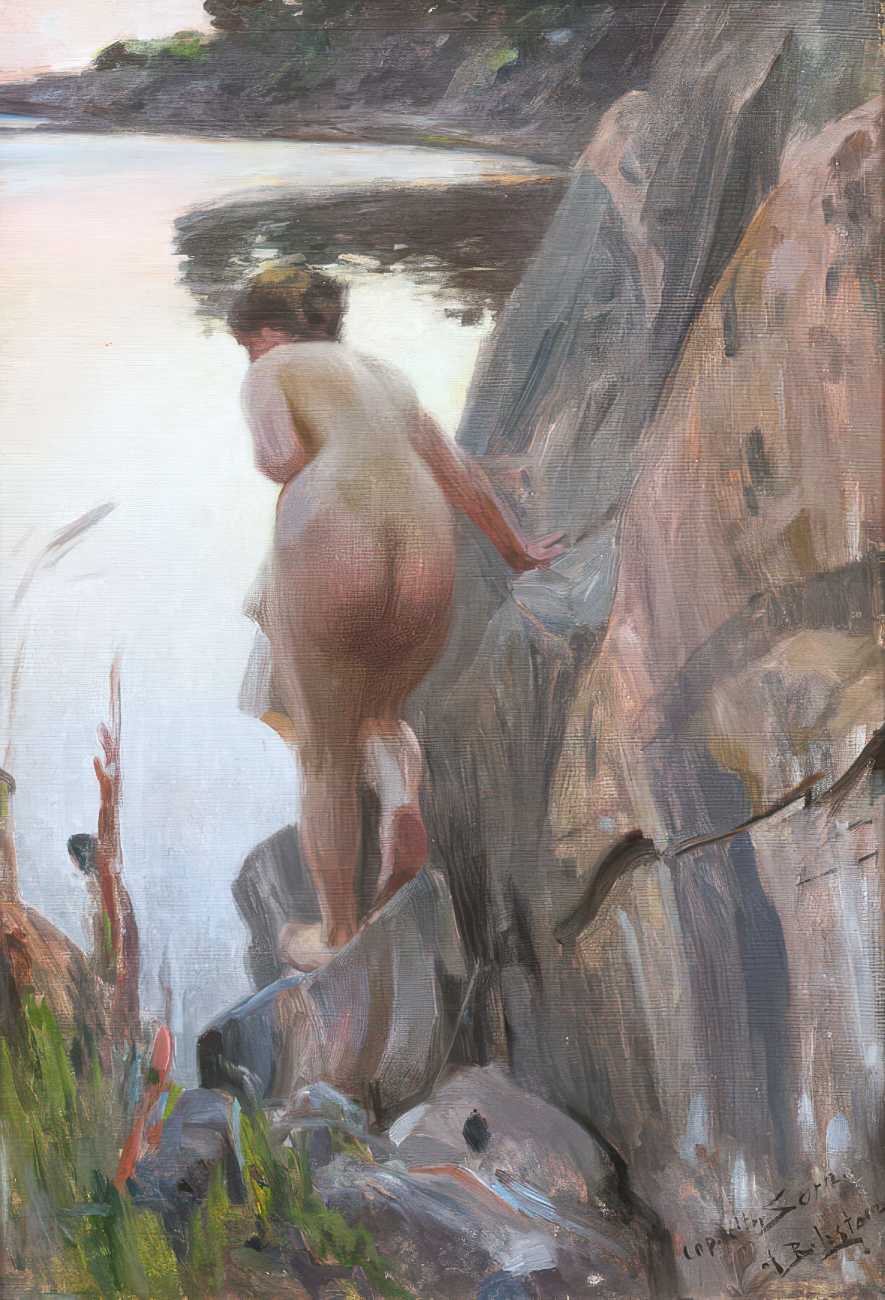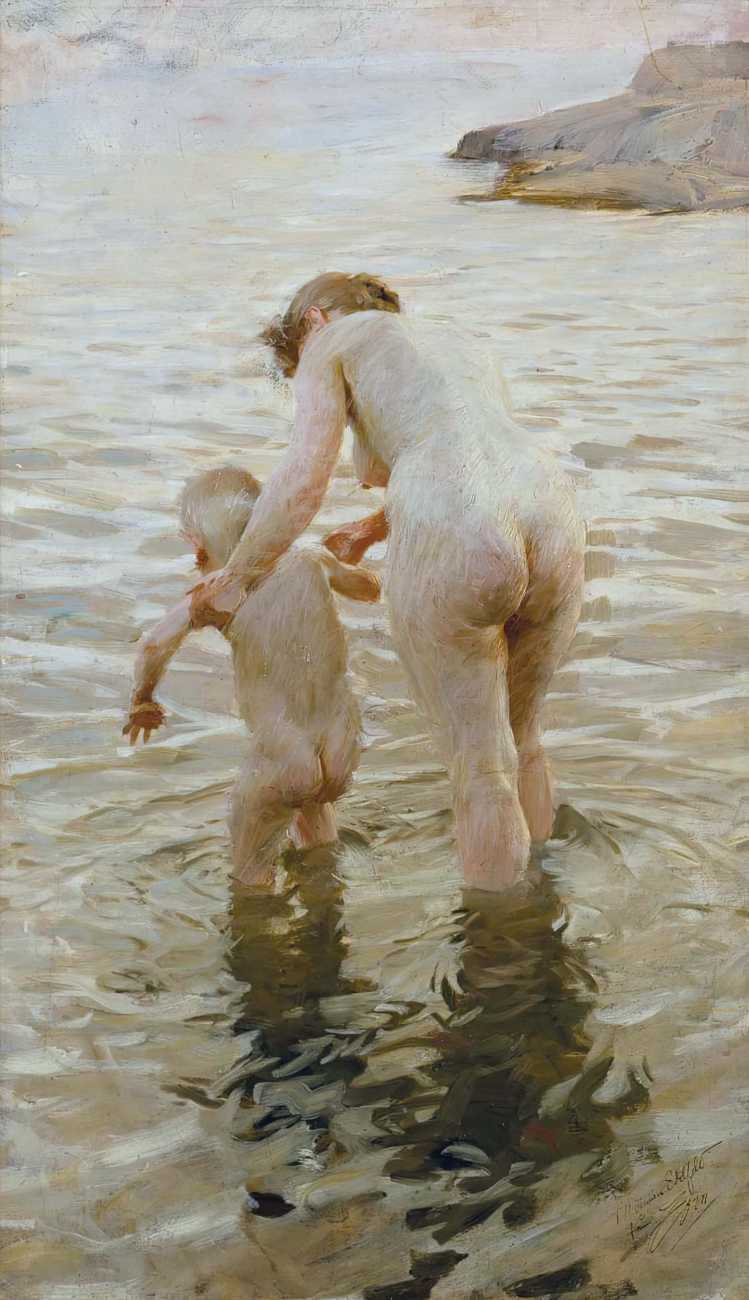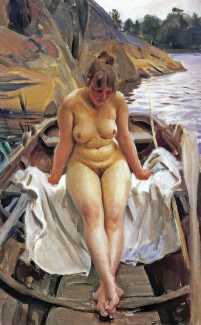
Although Anders and his wife Emma were devoted to each other, Zorn was very much a lady’s man, and was known for his many affairs. From around 1885 he began the body of work that today largely defines his reputation – naked women painted in outdoor natural settings, by the lakes, river shallows, reed beds and twilight shorelines around Mora. We shall never know to what extent the secluded locations helped him cover his amorous tracks, but the results were remarkable in reinventing ‘the female nude’, powerful and fertile, seemingly unconscious of her sensuality. His pictures were startling in their time because they were neither mythological nor allegorical – the women are not nymphs, Dianas or Venuses. They are recognisably contemporary rural bathers, often sturdy local models, standing naked in cold northern water.
And they are clearly unposed – Zorn was frustrated with the results when he posed the model. It was only when he allowed her to act naturally that he was satisfied with the result. In his memoir he wrote ‘I tried to place my model in various positions to achieve this or that effect, but it was when she was allowed to rest and felt unobserved that I discovered my painting.’
Technically the paintings are demonstrations of astonishing control. Using a limited palette which came to be known as ‘the Zorn palette’ – lead white, yellow ochre, vermilion and ivory black – he rendered wet skin, reflected light, and the shifting transparency of water with rapid brushwork. Water is often the main subject as much as flesh – ripples break the figure into fragments, reflections duplicate the body, and the boundary between figure and environment dissolves.
Though the reception for his naked-women paintings was mixed, and in many cases hostile and critical, Zorn had a growing band of appreciative critics. In 1913 J. Nilsen Laurvik, an art critic and independent curator, wrote a monograph on Zorn, explaining that, ‘With a few swift, sure strokes Zorn gives us the soft contour, the undulating curves of the fresh, firm flesh, of these strong-limped Junos. The nudes of Rembrandt would look singularly coarse and heavy by comparison with these silvery, exquisitely modelled Brunhildas of Zorn, who deport themselves on the sunlit beach or emerge from the enveloping shadow of some protruding cliff with a child-like unconsciousness and a pagan naïveté that disarm prudish prejudices. These big, blond women, whose naked bodies move with unrestrained freedom through the tonic, balsam air, are imbued with a superb, healthy animalism such as has never been depicted in the whole history of art. Zorn delights in portraying these sturdy, flaxen-haired peasants in all the unconscious abandon of their naïve natures, and the series of plates celebrating the intimate life of these people are the most authentic expressions of his art because the most closely related to the mainsprings of his personality.’
The eroticism in Zorn’s paintings is direct but complex. Zorn was not painting academic ideal beauty – his models have weight, muscle, and sometimes an awkward posture. They appear to be unaware of the viewer, absorbed in washing or stepping into water, others glance back over their shoulder. The setting intensifies the charge: these are secluded, liminal spaces where social rules are suspended. The paintings invite a voyeuristic reading, yet their physicality resists titillation. The women are robust, self-possessed and at ease, inhabitants of the nature surrounding them.