Between 1945 and 1949 Paul Cadmus created one of the most unusual series of his career – a sequence of paintings personifying the seven deadly sins. Rather than depicting ordinary people behaving badly, Cadmus transformed each vice into a disturbing symbolic creature. Anger erupts as a blazing beast smashing through glass; sloth dissolves into a decaying figure almost consumed by its surroundings; lust becomes an unsettling hybrid of human body and sexual imagery; while gluttony, avarice and pride appear as monstrous embodiments of excess and self-absorption. The series marked a rare departure from the social realism and crowded urban scenes for which Cadmus was best known, moving towards an imaginative world of allegory and nightmare. Contemporary critics often described the paintings as surreal, although Cadmus himself resisted that label.
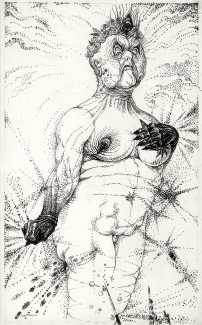
The idea of representing the seven deadly sins has a long history stretching back to medieval art and literature, yet Cadmus approached the subject less as a religious exercise than as an exploration of universal human failings. His figures remain recognisably human, yet each has been transformed by obsession until vice has become physical form. Colour plays a crucial role – violent reds for anger, sickly greens for envy, cold greys for sloth and rich, seductive tones for lust reinforce the emotional character of each painting.
Several decades later Cadmus returned to the subject, adding an eighth painting, jealousy. Although jealousy and envy are often treated as closely related emotions, Cadmus distinguished between them, presenting jealousy as a separate psychological state worthy of its own personification. The final addition, shame, was created in 1992. Rather than a painting like all the others, it is a highly finished crayon and pencil drawing – Cadmus was inspired to create it out of indignation after a magazine image of Masaccio’s classic renaissance fresco, The Expulsion of Adam and Eve, was publicly condemned as pornography simply for depicting nudity.
Alongside the finished paintings, Cadmus produced detailed preparatory drawings, one of which is included here. These studies reveal the extraordinary care with which he developed each figure before transferring it to canvas. Even in his most fantastic creations Cadmus relied upon his lifelong mastery of drawing and anatomy, ensuring that the most impossible monsters remain strangely convincing.