
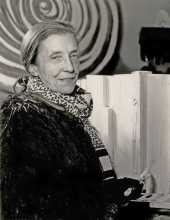
 Louise Bourgeois grew up in a Parisian family that specialised in restoring antique tapestries. As a child she helped draw the missing sections of damaged fabrics before they were rewoven, an experience that left a lasting impression. Ideas of repair, fragmentation and reconstruction would remain central throughout her career. Equally influential was the turbulent atmosphere within her family. Her father’s long affair with the family’s English governess created emotional wounds that Bourgeois revisited repeatedly through her art, while her devotion to her patient, practical mother inspired many of her later reflections on protection, resilience and motherhood.
Bourgeois studied mathematics and philosophy at school, and later took calculus and solid geometry at the Sorbonne, before turning to art in 1936, four years after her mother’s death. She studied in Paris under several artists, including Fernand Léger, before marrying the American art historian Robert Goldwater in 1938 and settling permanently in New York. Although she exhibited from the 1940s onwards, recognition came slowly. Only in later life did museums and critics fully appreciate the originality of her work, leading to major retrospectives and international acclaim.
Bourgeois insisted that her work grew directly from lived experience, yet she resisted attempts to explain it solely through autobiography or psychoanalysis. ‘Art is a guarantee of sanity,’ she famously remarked, describing creative practice as a means of transforming fear, anxiety and emotional conflict into form. She was less interested in illustrating ideas than in discovering them through making. ‘It is not the appearance of the body that interests me – clothed or unclothed,’ she explained. ‘I want to know how things work – and why.’
The human body became one of her principal subjects. Limbs merge into architecture, breasts become eyes, penises resemble infants, and male and female characteristics flow into one another with unsettling ease. Bourgeois repeatedly challenged conventional ideas of gender, identity and sexuality, treating the body as a place where memory, desire, vulnerability and power are continually negotiated. Although many viewers regarded her work as overtly erotic, she insisted that she was ‘exclusively concerned with formal perfection’, allowing images to emerge intuitively rather than pursuing eroticism for its own sake.
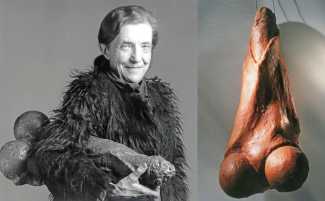
Bourgeois is often thought of as a creator of sculptures, using organic, biomorphic shapesn to explore sexuality, the unconscious, and the human body. Her provocative works blend the phallic and the maternal with wry humour, often utilising unconventional hanging formats and tactile materials like latex, rubber, plaster and bronze.
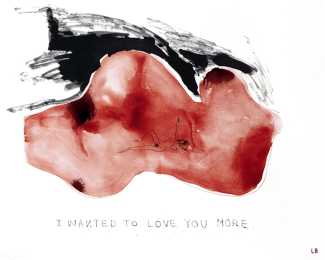
Towards the end of her life Bourgeois collaborated with the younger British artist Tracey Emin entitled Do Not Abandon Me (2009–10), a remarkable suite in which Bourgeois’ fluid body forms were paired with Emin’s handwritten texts. The result became a dialogue between two artists from different generations, united by a shared willingness to explore love, desire, vulnerability and loss.
Today Louise Bourgeois is recognised as one of the most influential artists of the modern era. Whether working in drawing, printmaking, textiles or sculpture, she transformed intensely personal experience into images that speak with extraordinary emotional and psychological force. By refusing simple distinctions between masculine and feminine, pleasure and pain, love and violence, she created an intensely individual vision.
In 1975 the art critic Lucy Lippard wrote an excellent article in Artforum about Louise Bourgeois’ work, which you can read in full here. We have extracted a few paragraphs to give a flavour of the piece.
The major function of Louise Bourgeois’ work is to follow the ‘inner necessity, to release anxiety into a formal perfection.’ Lovingly and fearfully woven and unwound from her own body and her own needs, her art’s sensuality can be so strong that it overwhelms all other considerations. Within the art – as, one suspects, within the artist – form and the formless are locked in constant combat. The outcome is an unusually exposed demonstration of the intimate bond between art and its maker.
Louise Bourgeois herself acknowledged that ‘People talked about erotic aspects, about my obsessions, but they didn’t discuss the phallic aspects. If they had, I would have ceased to do it. Now I admit the imagery. I am not embarrassed about it. When I was young, sex was talked of as a dangerous thing; sexuality was forbidden. At the École des Beaux-Arts, we had a nude male model. One day he looked around and saw a woman student and suddenly he had an erection. I was shocked. Then I thought what a fantastic thing, to reveal your vulnerability, to be so publicly exposed! We are all vulnerable in some way, and we are all male-female.’
Bourgeois’ images of women and woman’s experience are also ambivalent, juxtaposing a nurturing power of growth and emergence with the sharp threat of oppression. ‘A girl can be terrified of the world,’ she says. ‘She feels vulnerable because she can be wounded by the penis. So she tries to take on the weapon of the aggressor. These women are eternally reaching for a way of becoming women. Their anxiety comes from their doubt of being ever able to become receptive. The battle is fought at the terror level, which precedes anything sexual.’
Similar artists
Hans Bellmer – German-French surrealist of disturbing, sexualised doll imagery.
Judith Bernstein – American feminist artist of confrontational phallic-political imagery.
Carroll Dunham – American painter of cartoon-derived figures with prominent genitalia.
Tracey Emin – British artist and Bourgeois's late-life collaborator on Do Not Abandon Me.
Dorothy Iannone – American painter of narrative-erotic autobiographical subjects.
Pierre Molinier – French surrealist photographer and painter of fetishistic subjects.
Example illustration


