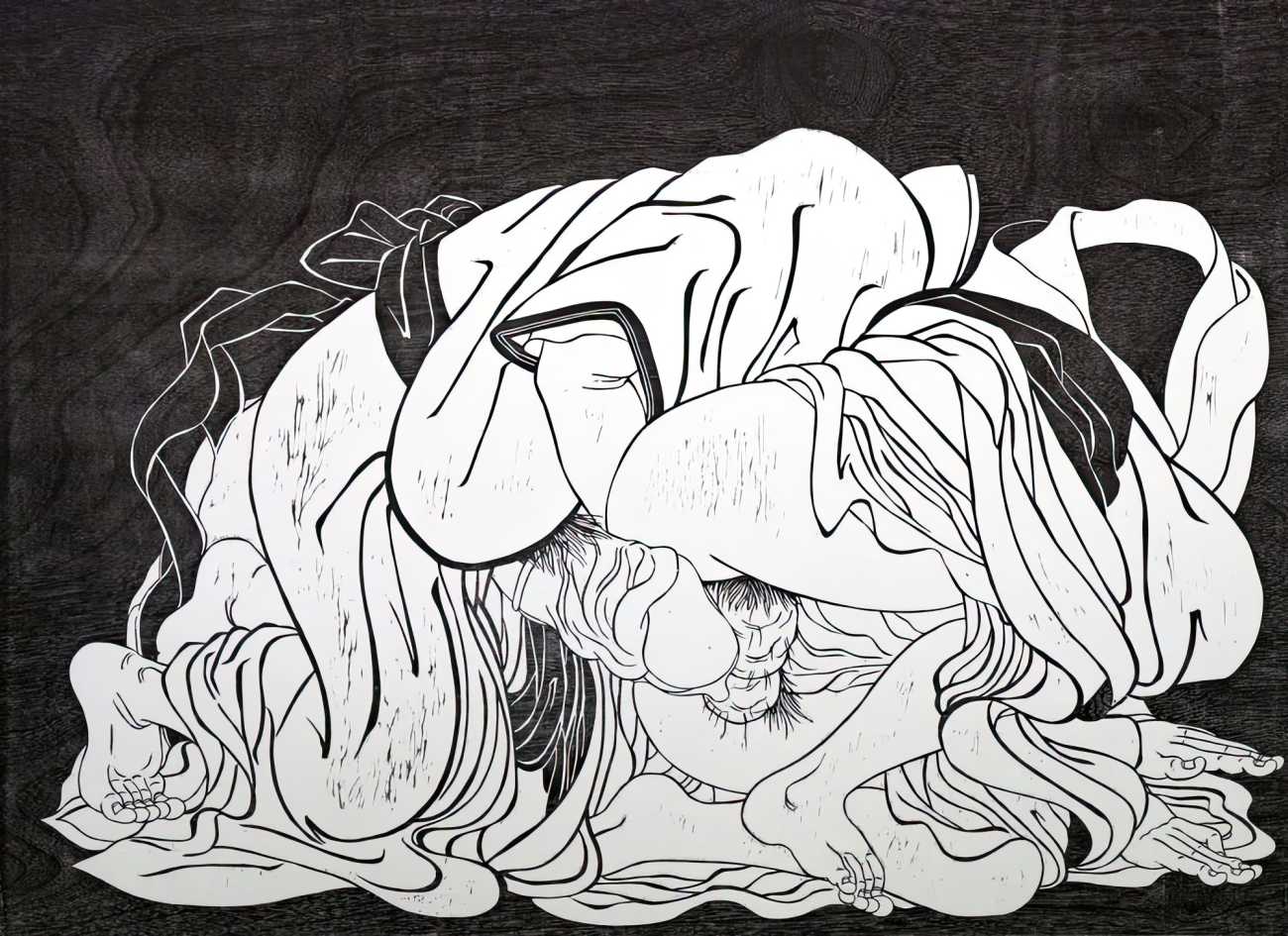
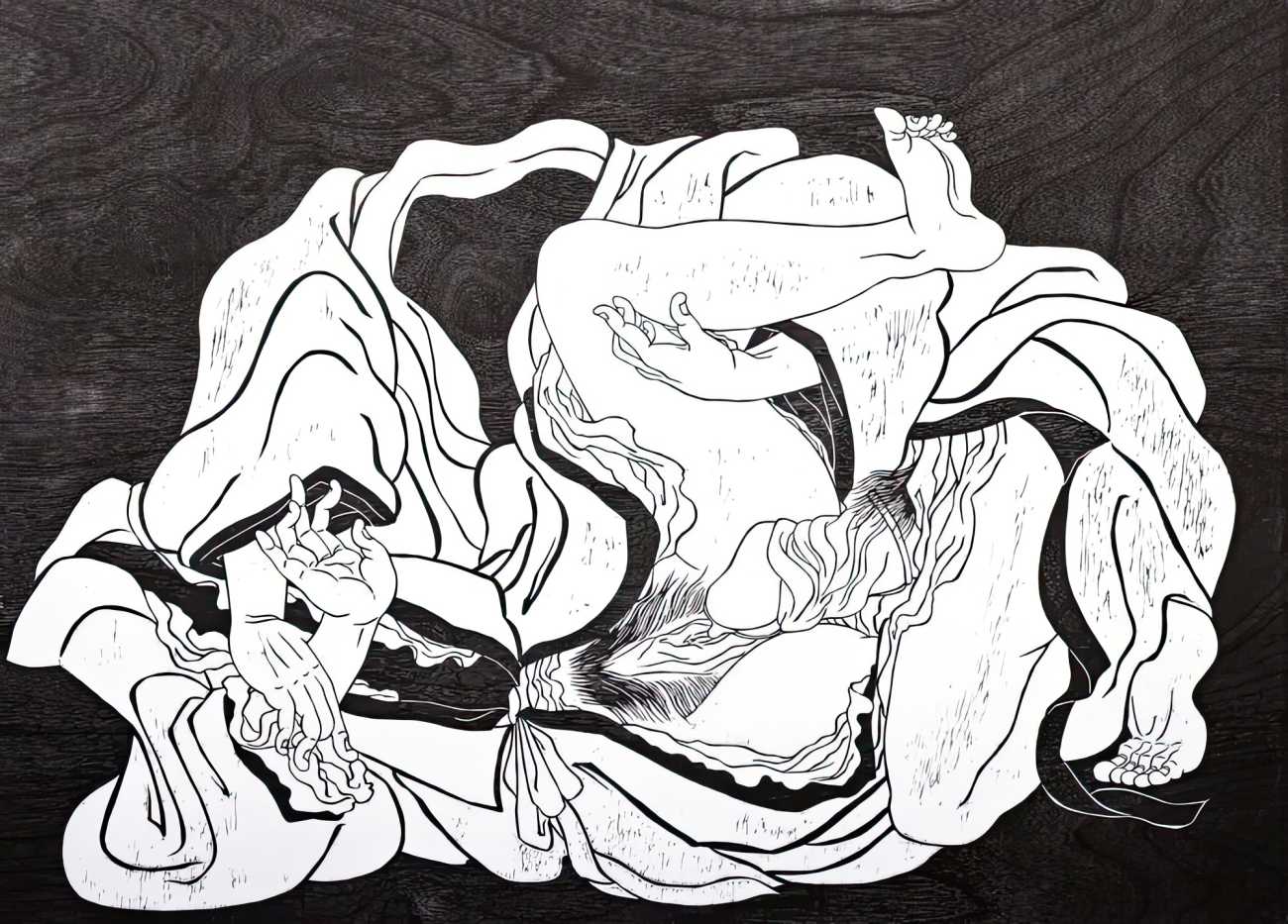
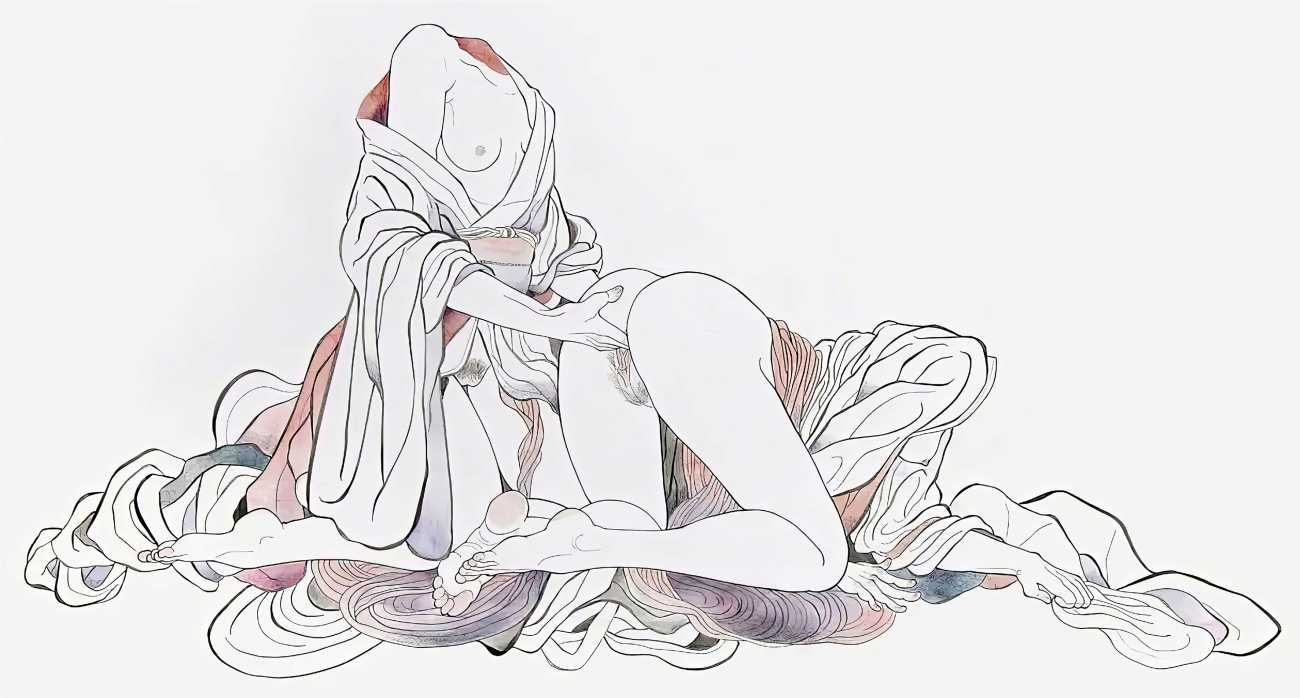
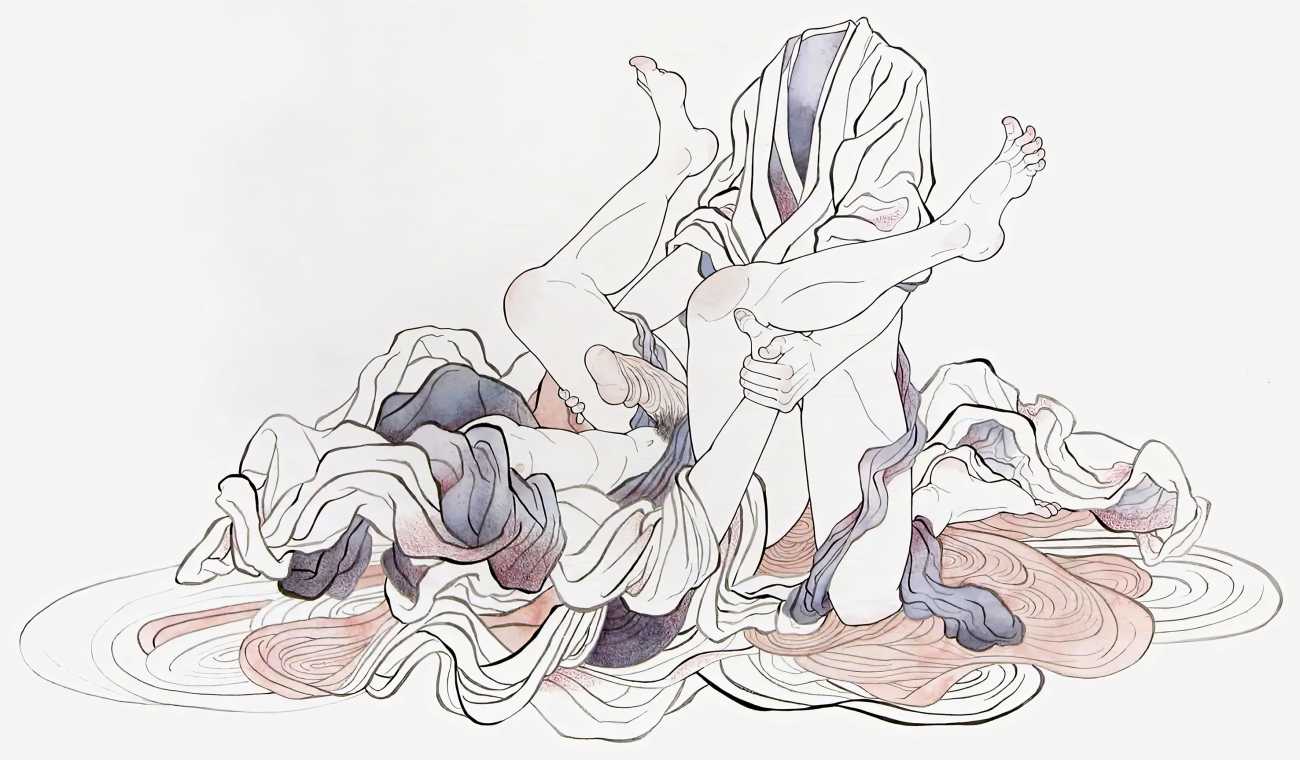
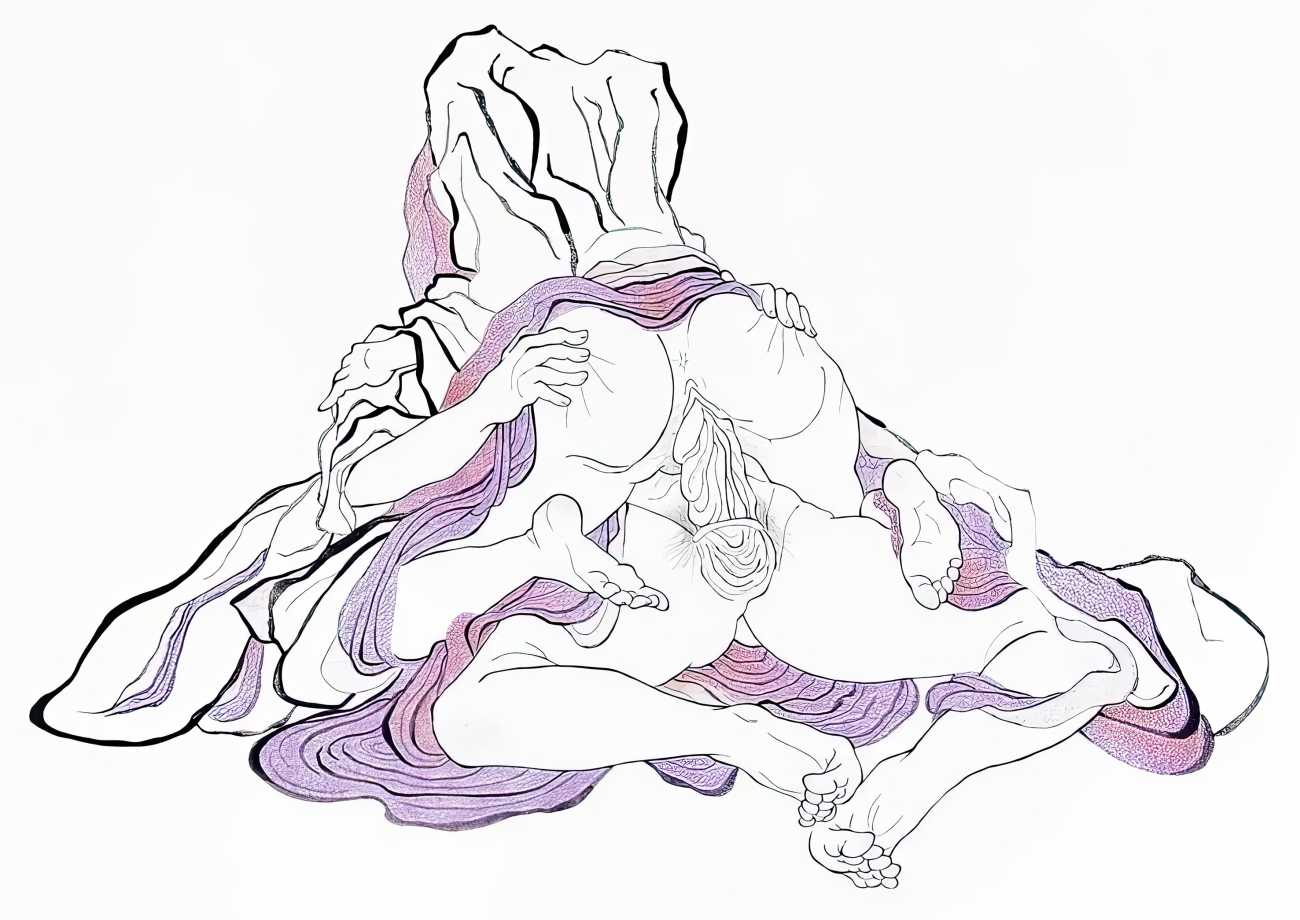
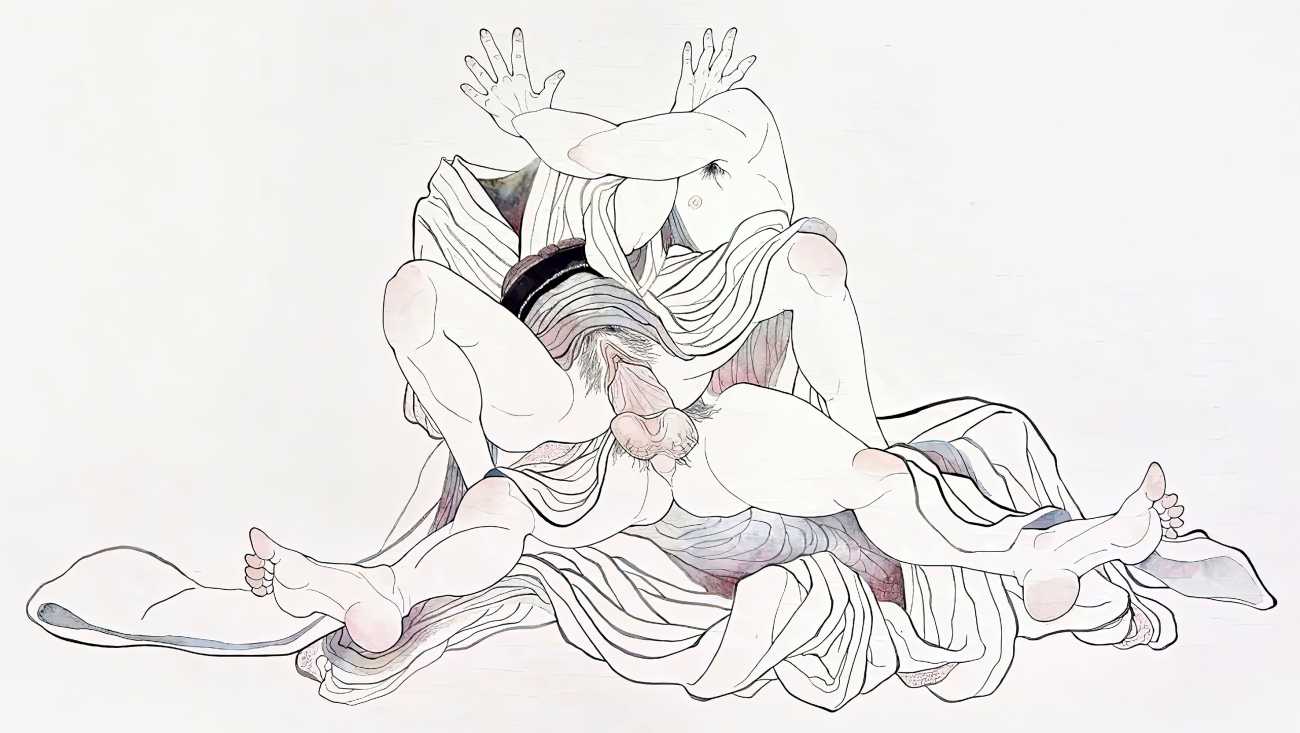
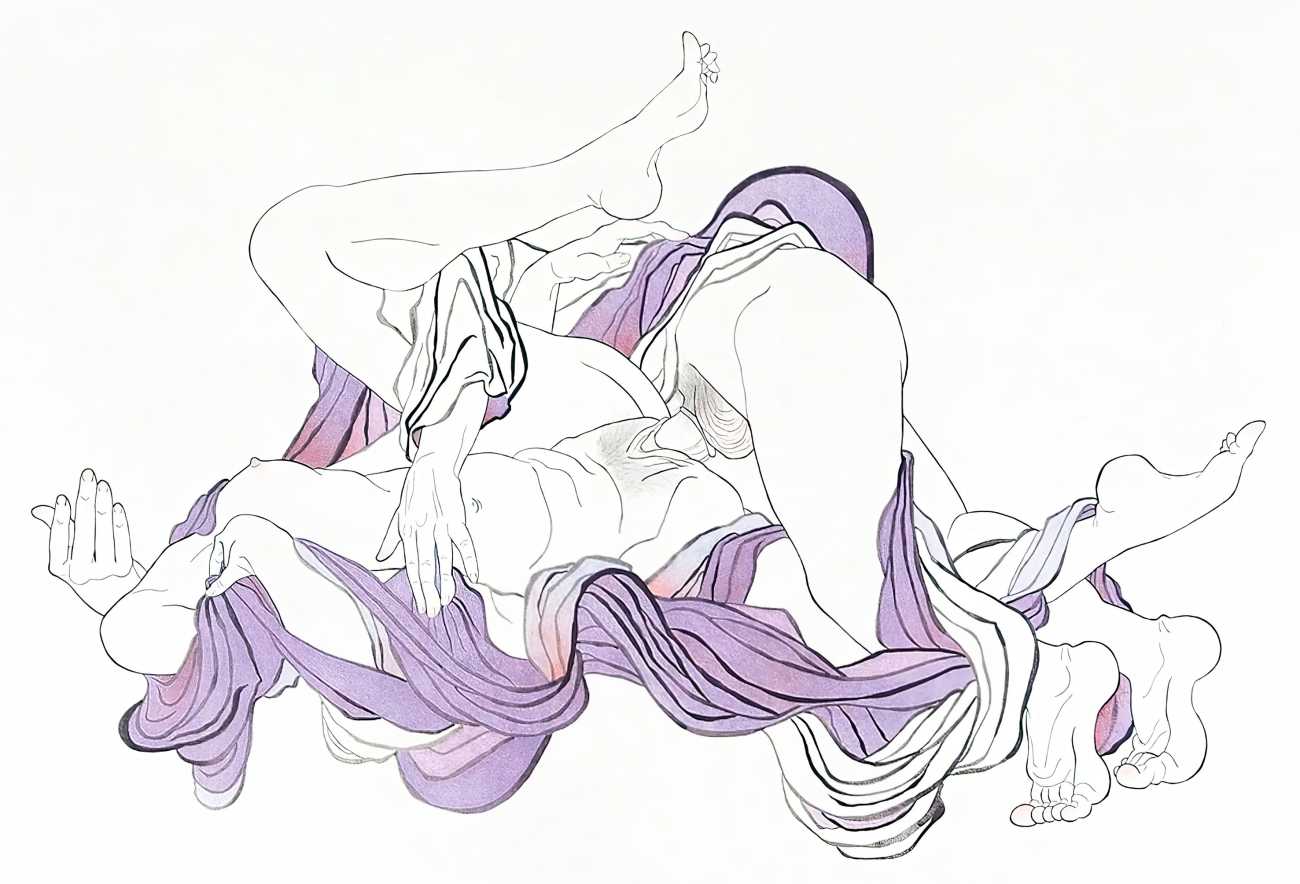
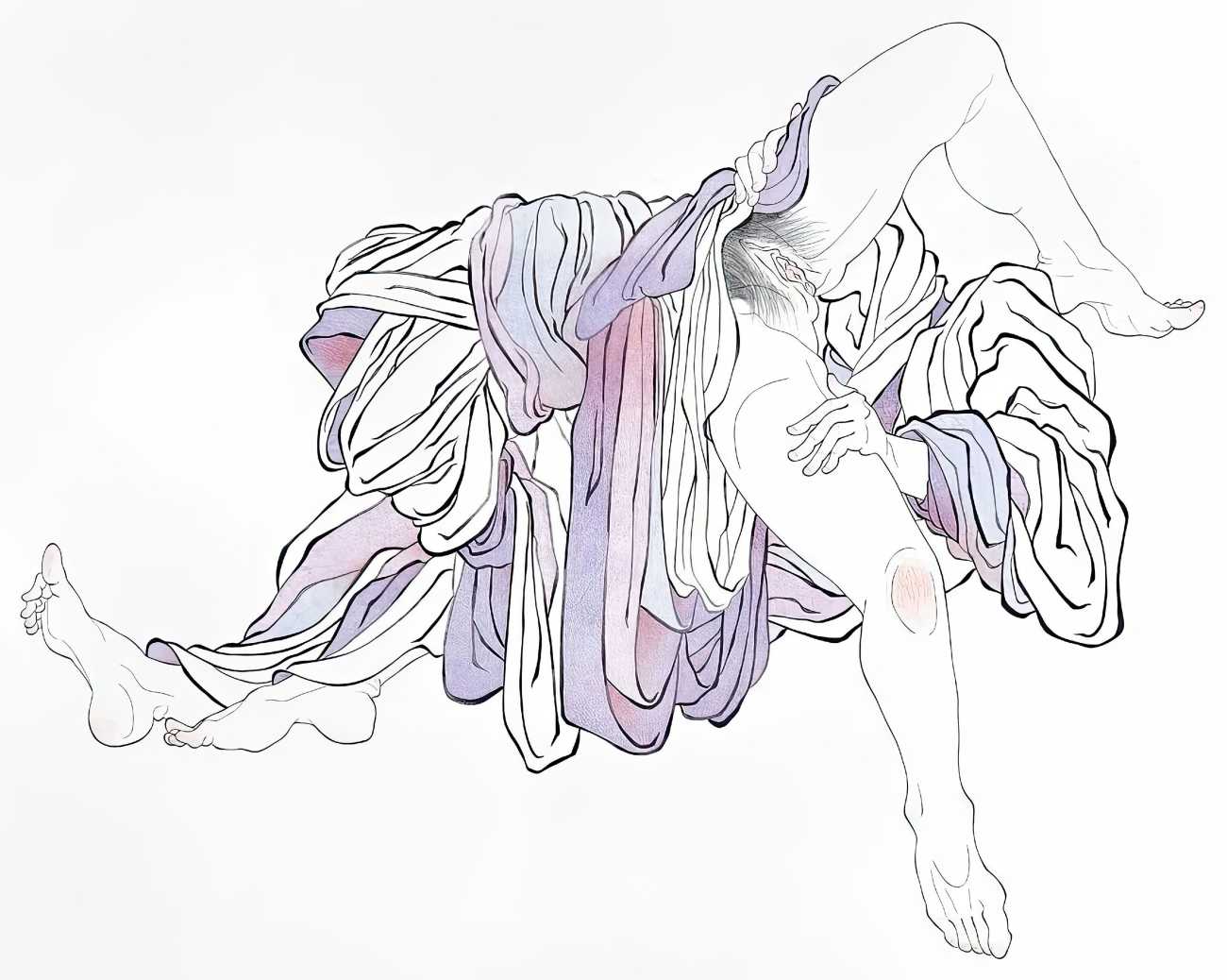
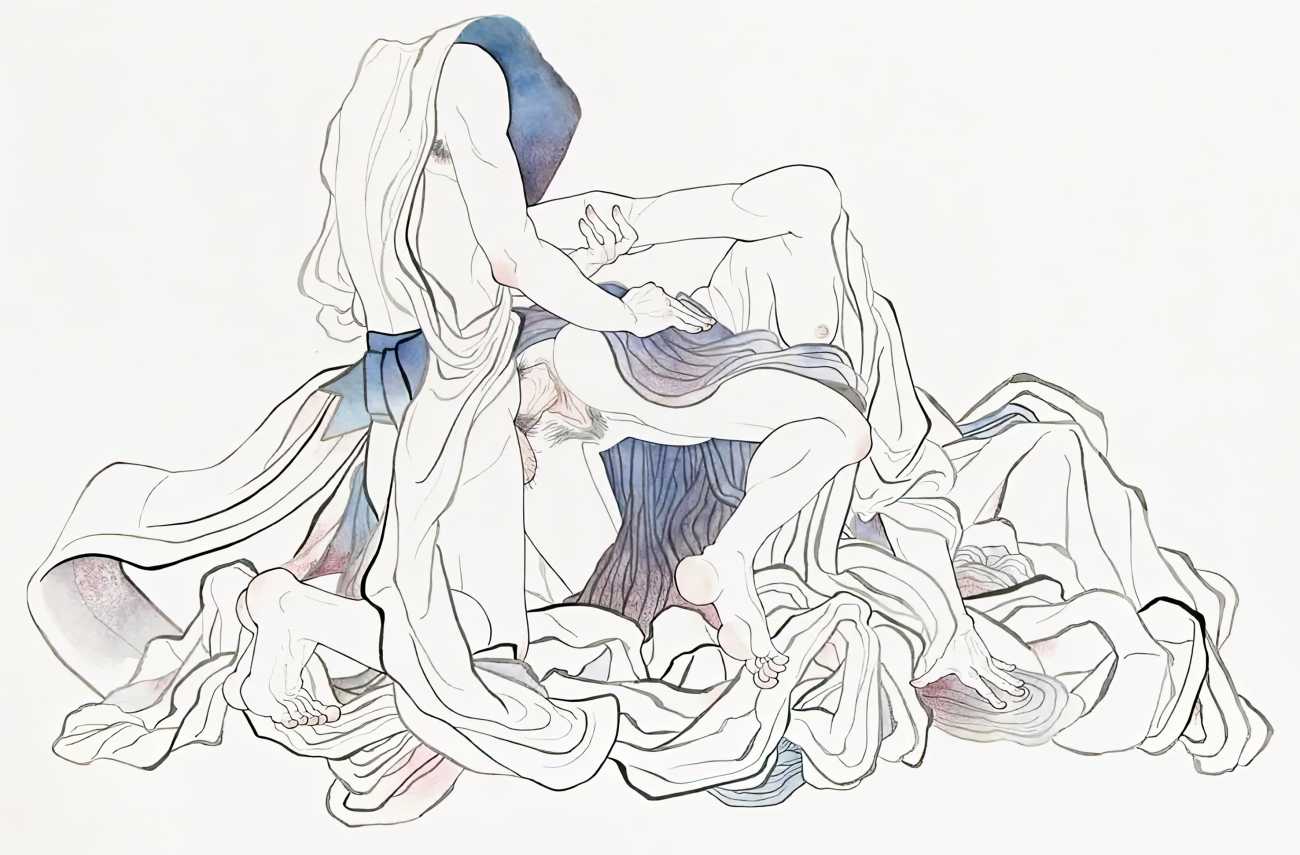
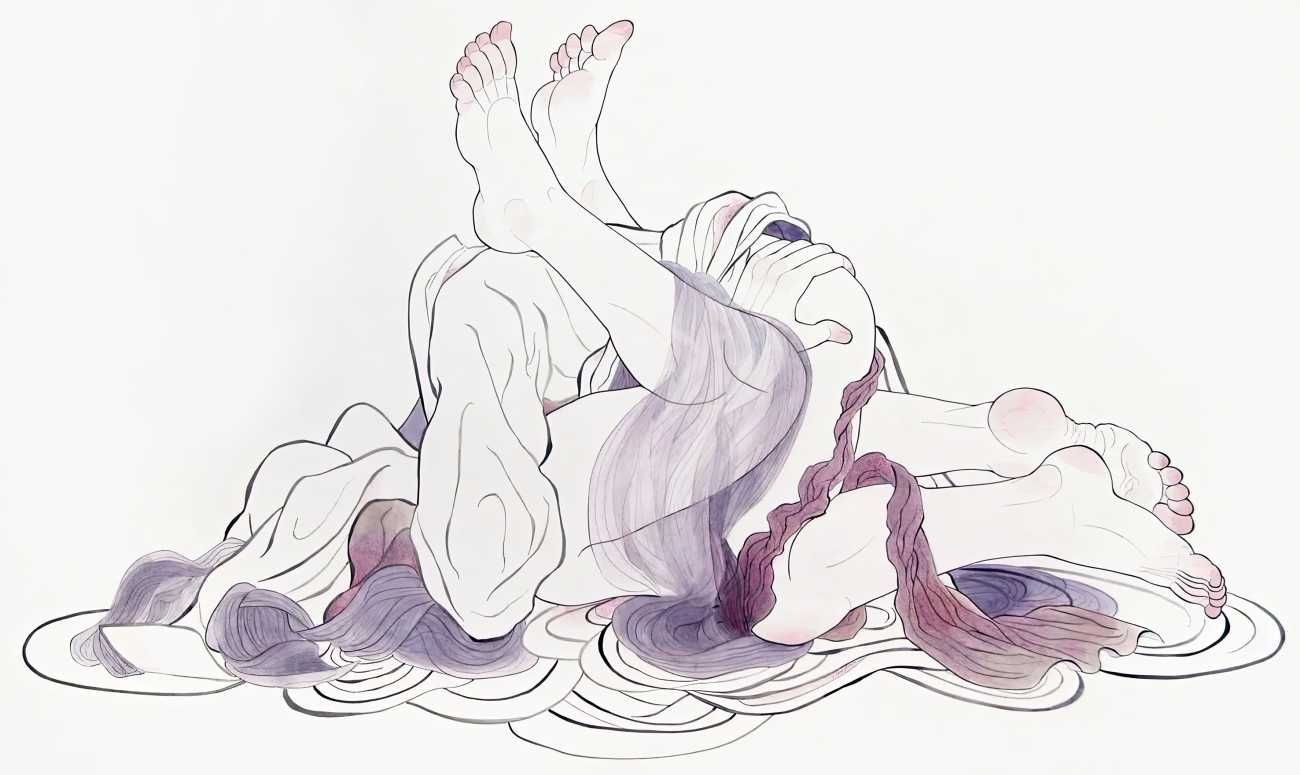
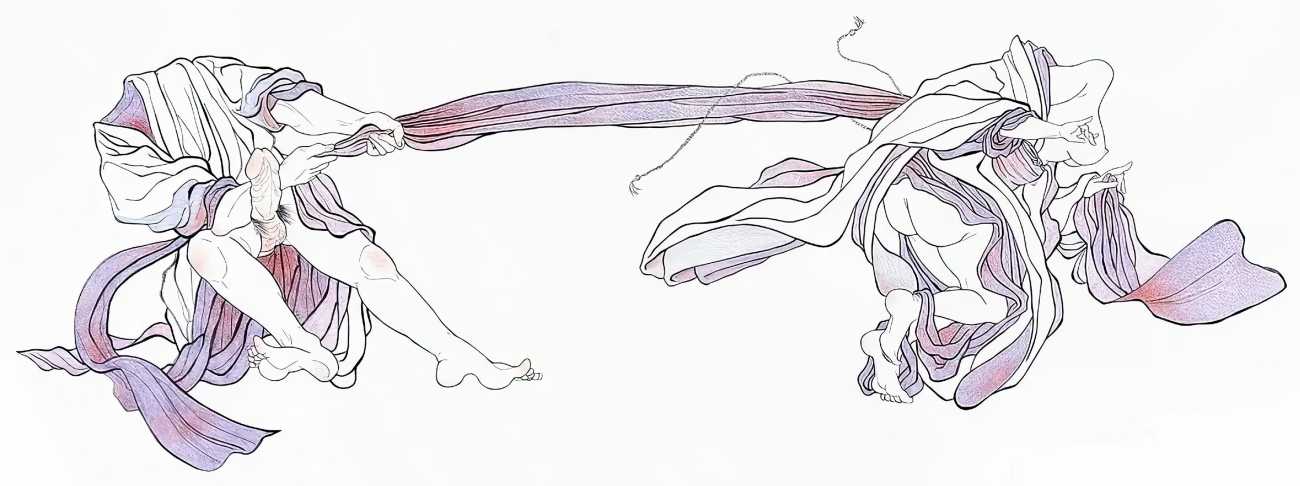
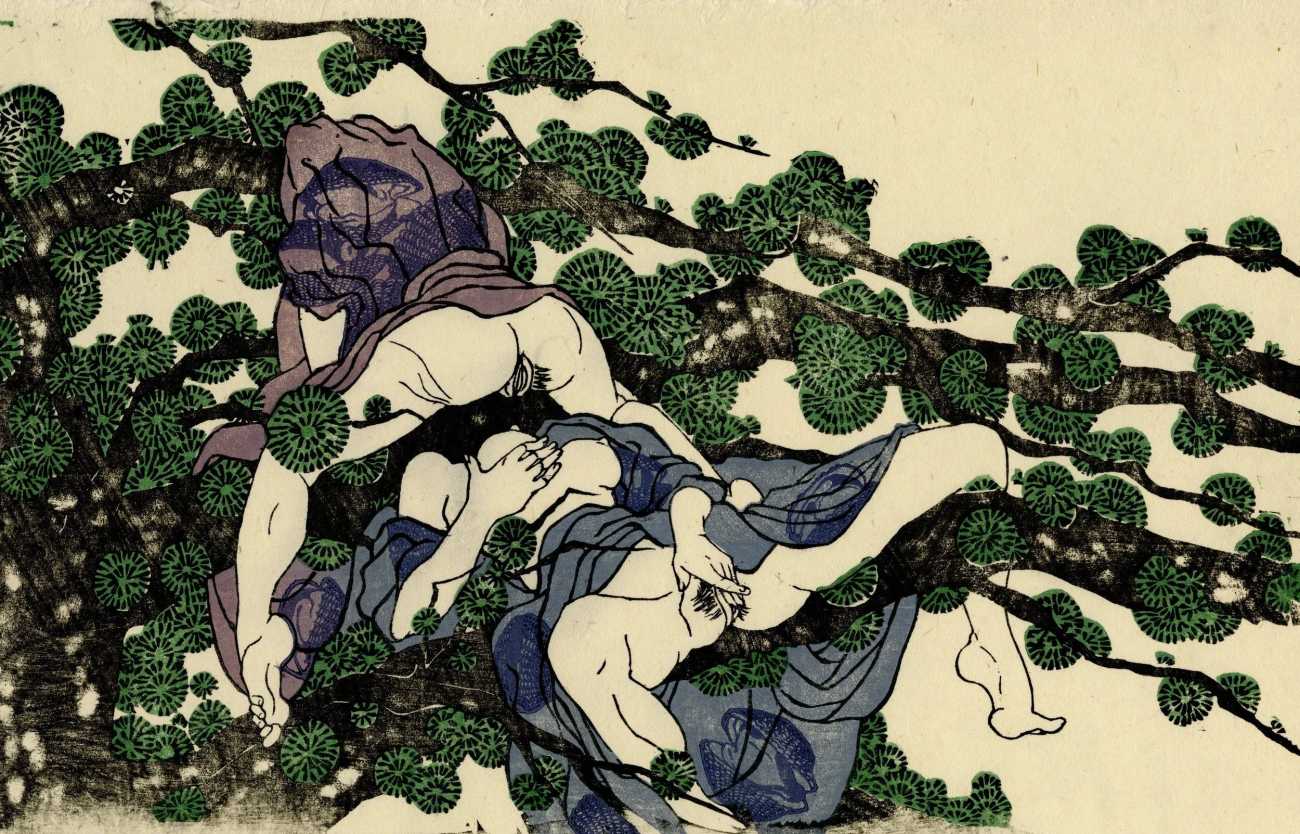
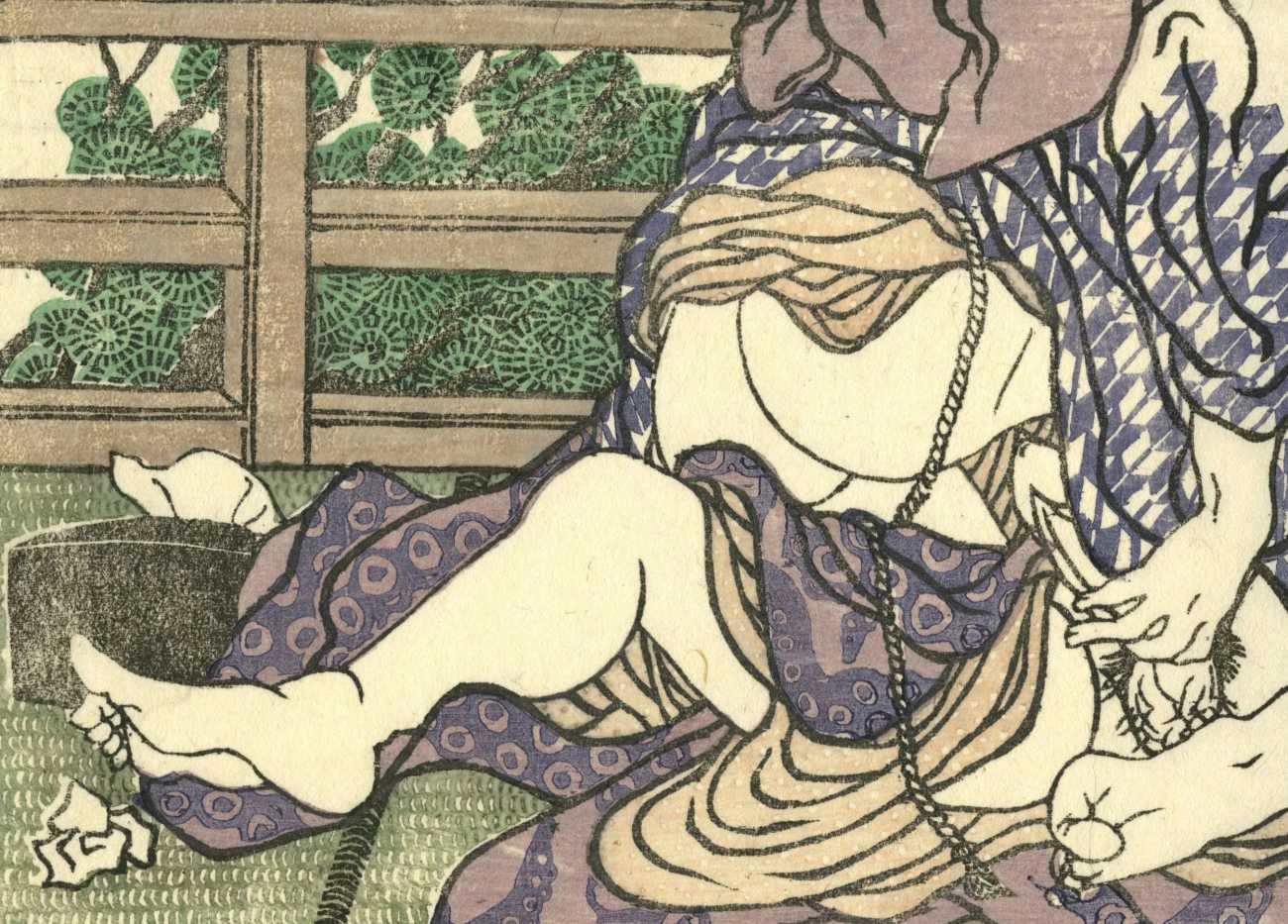
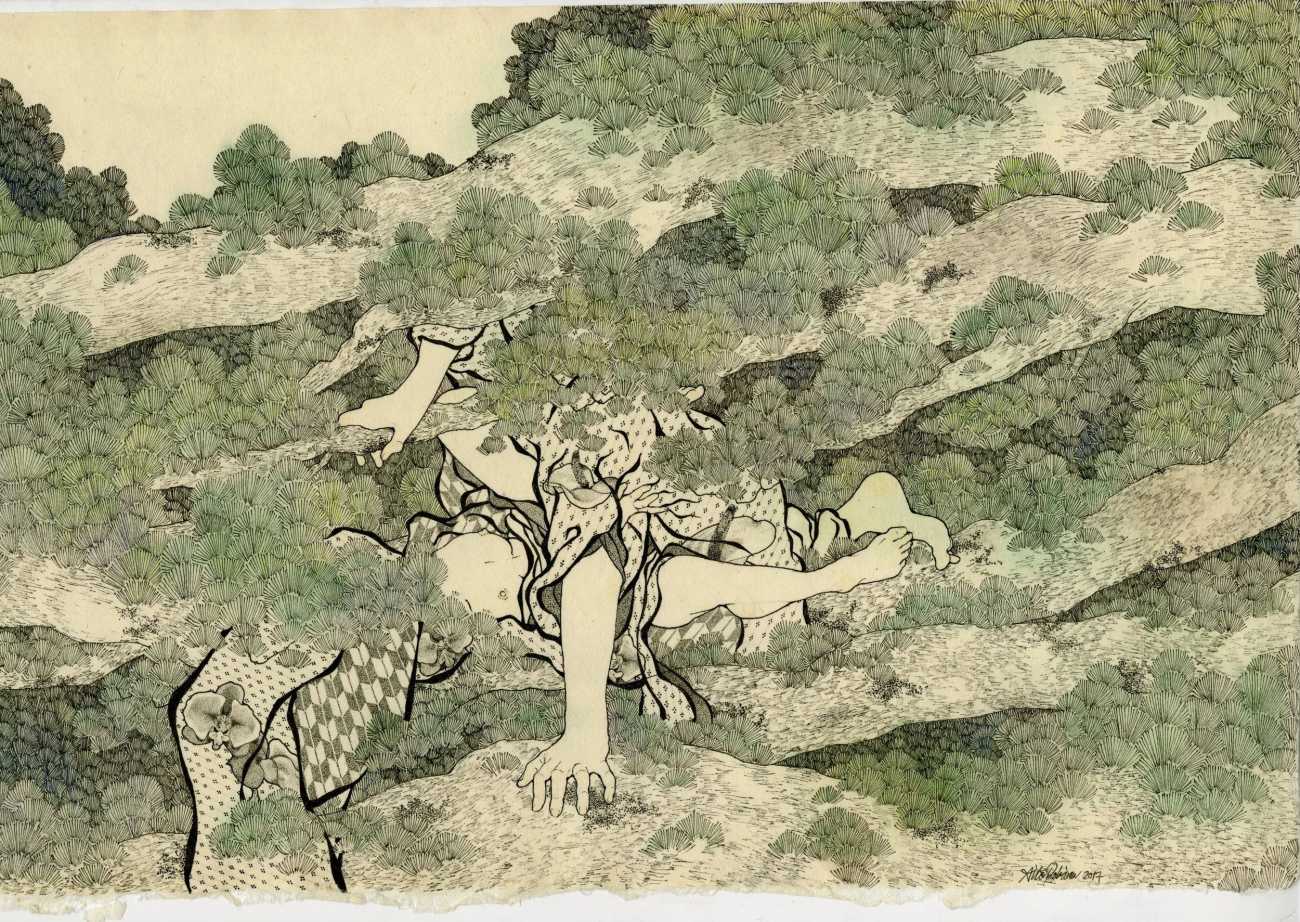
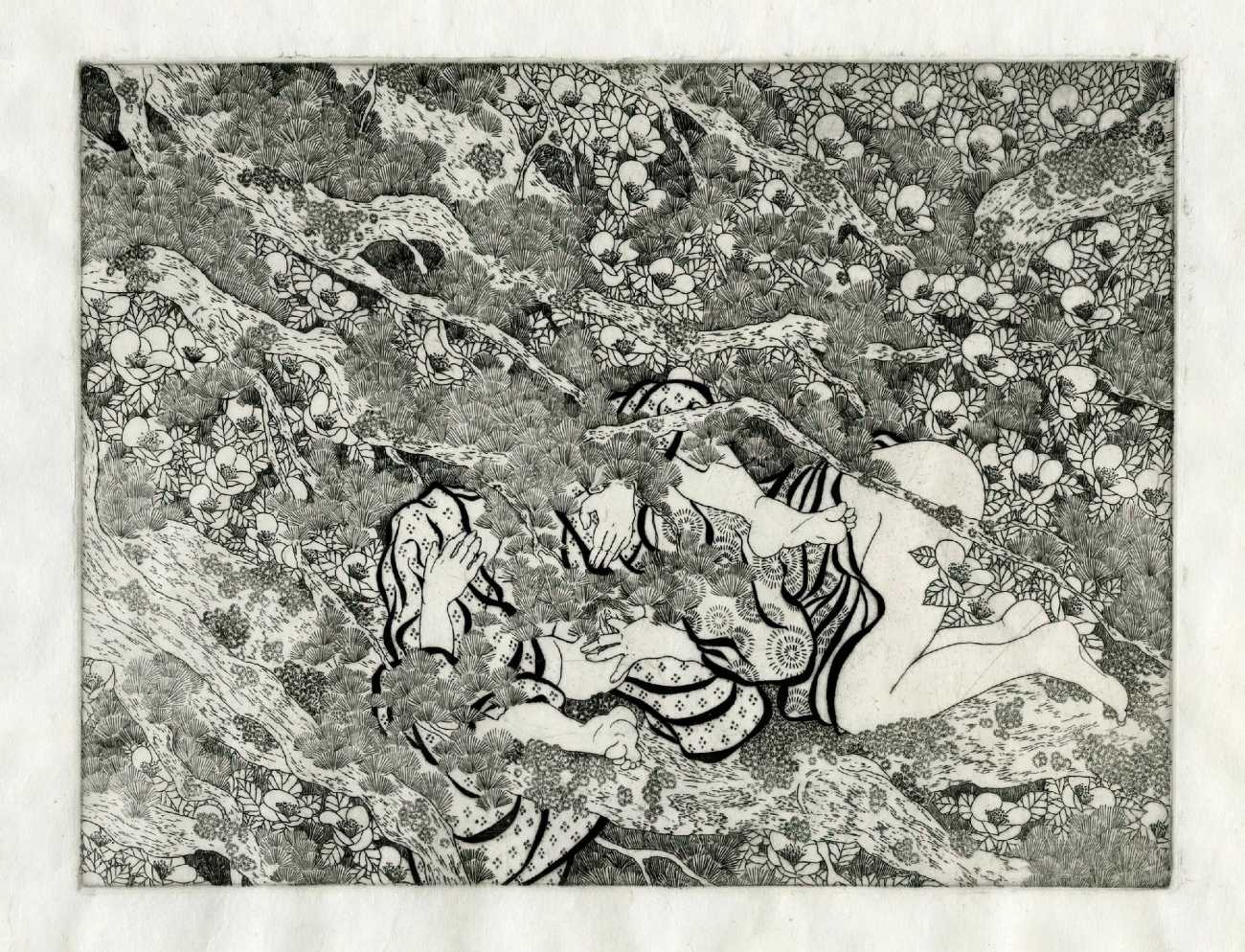
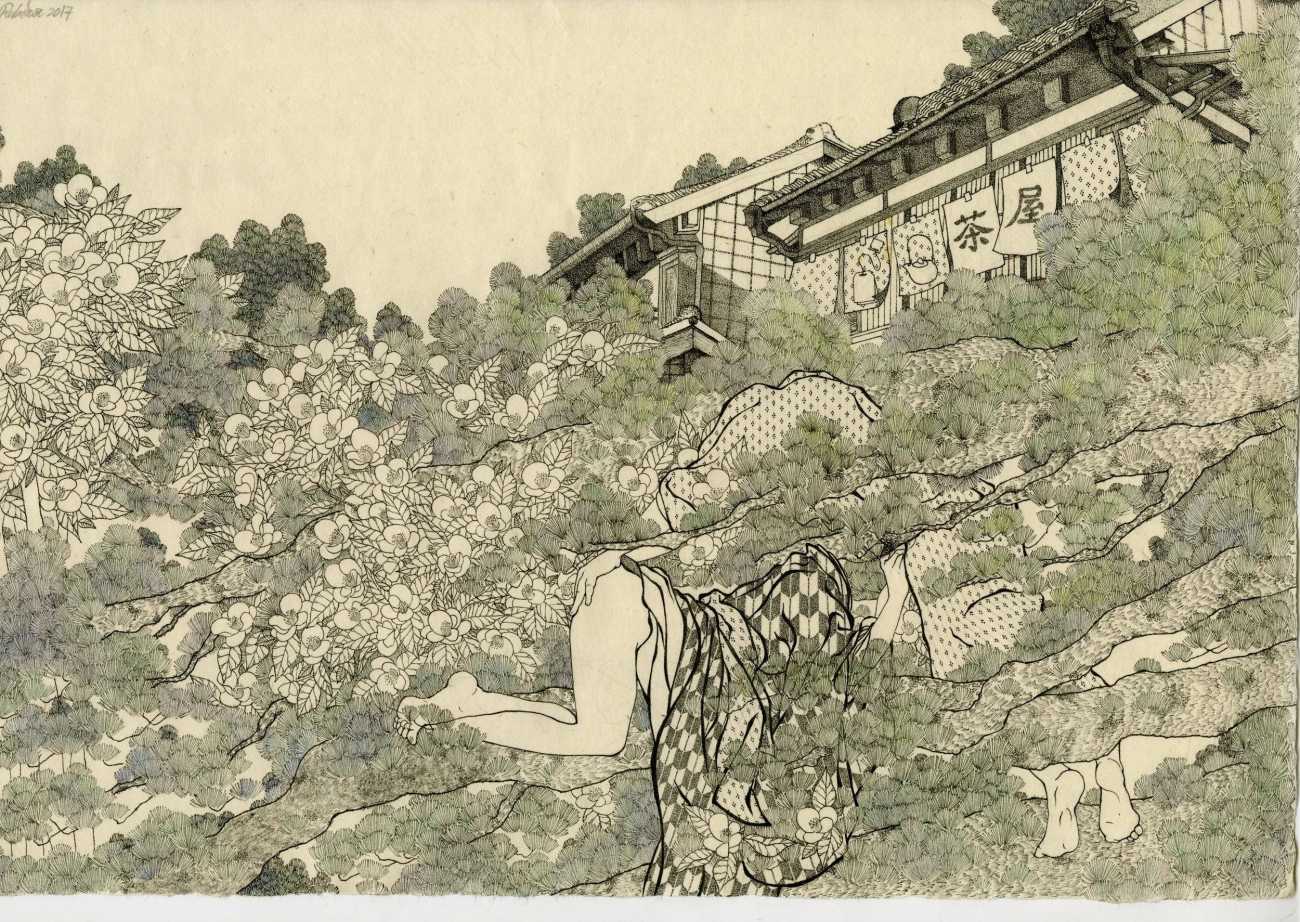
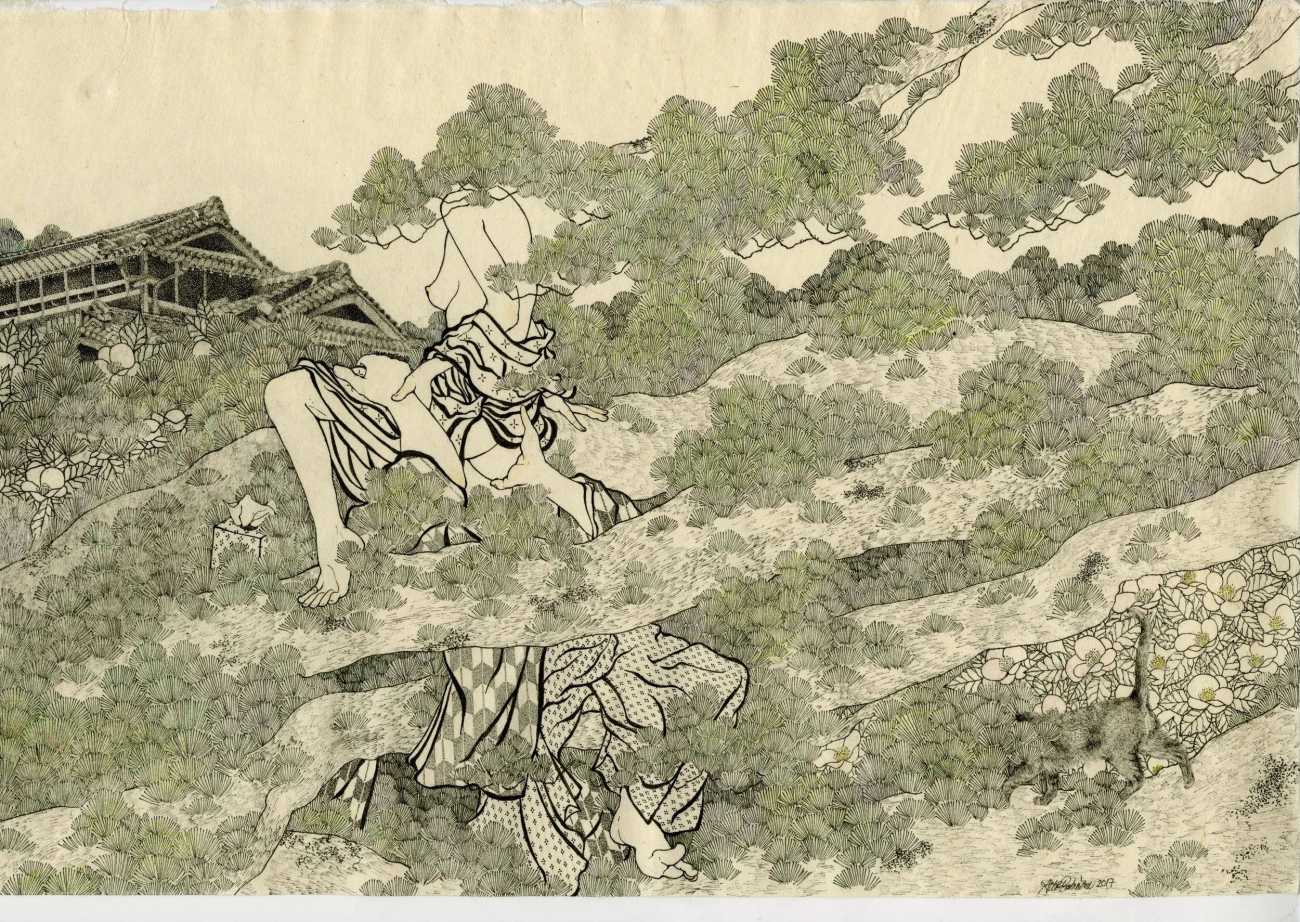
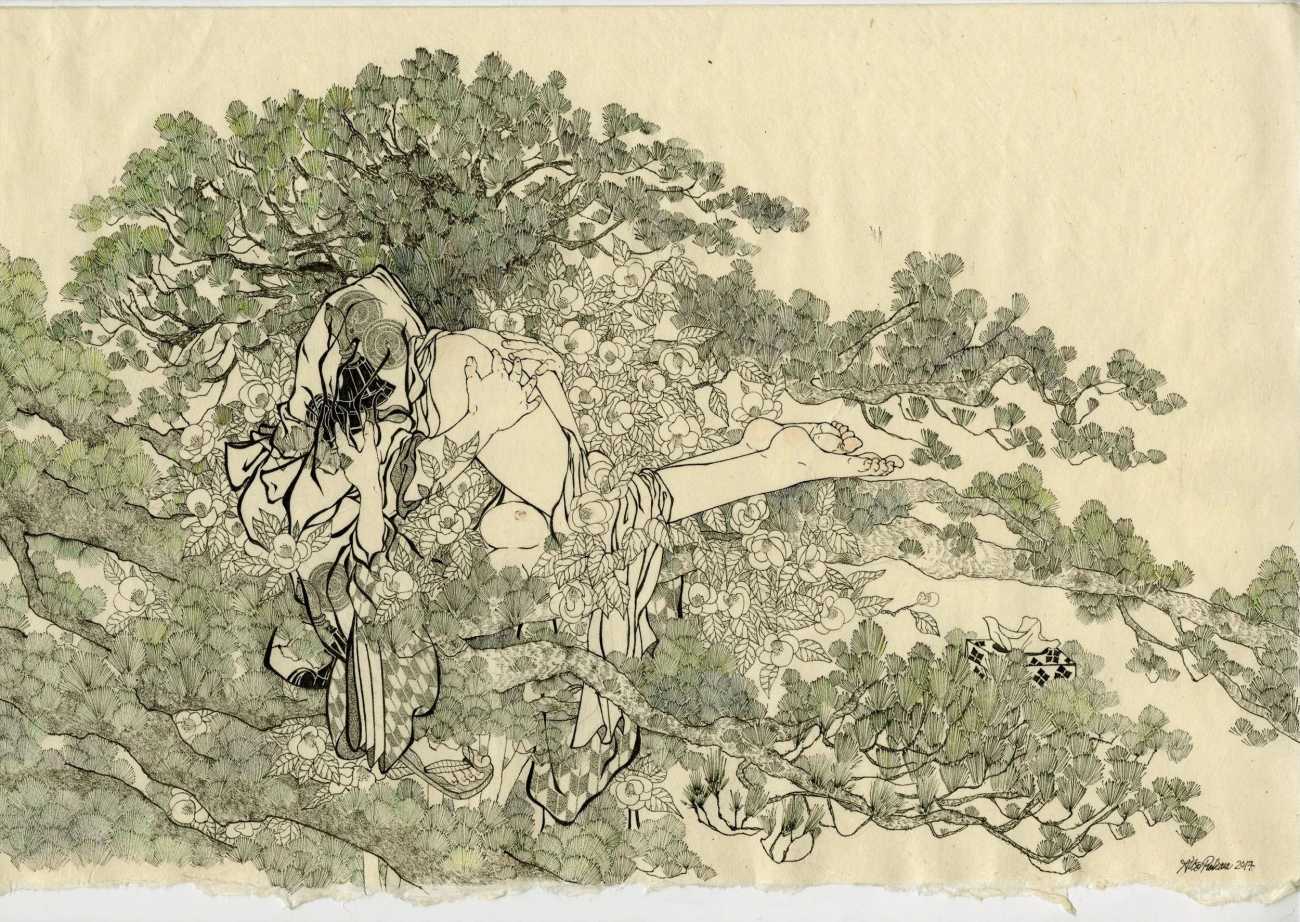
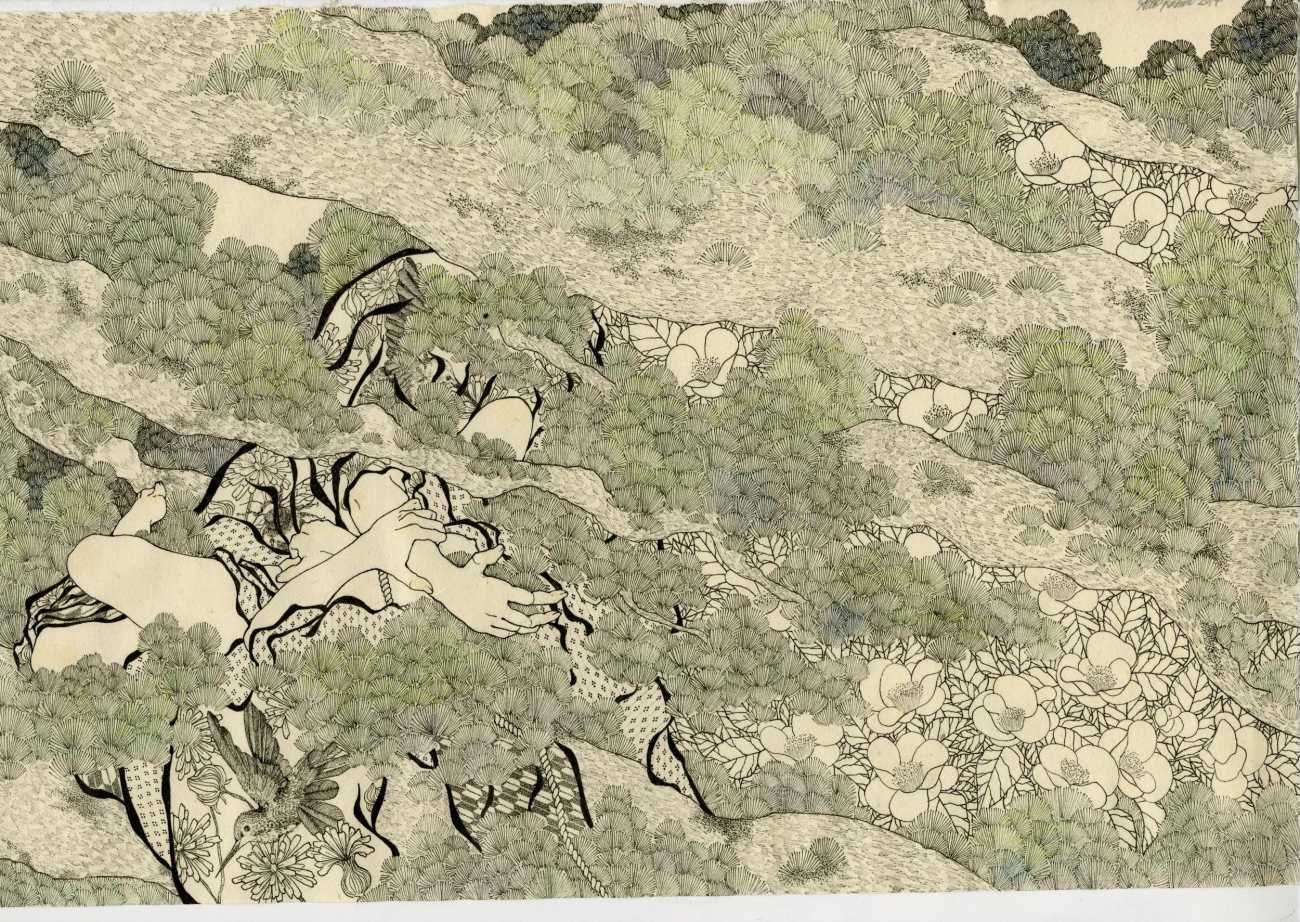
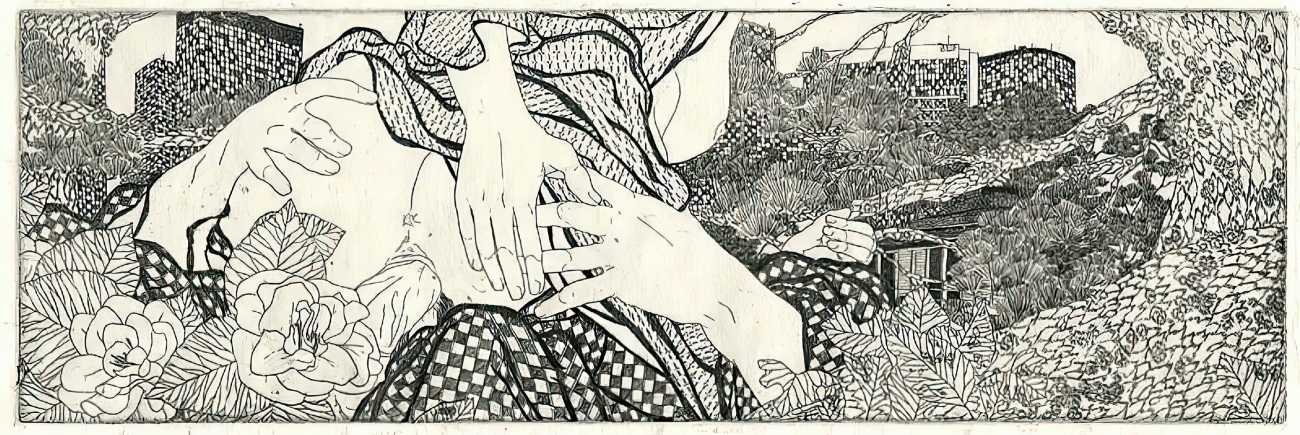
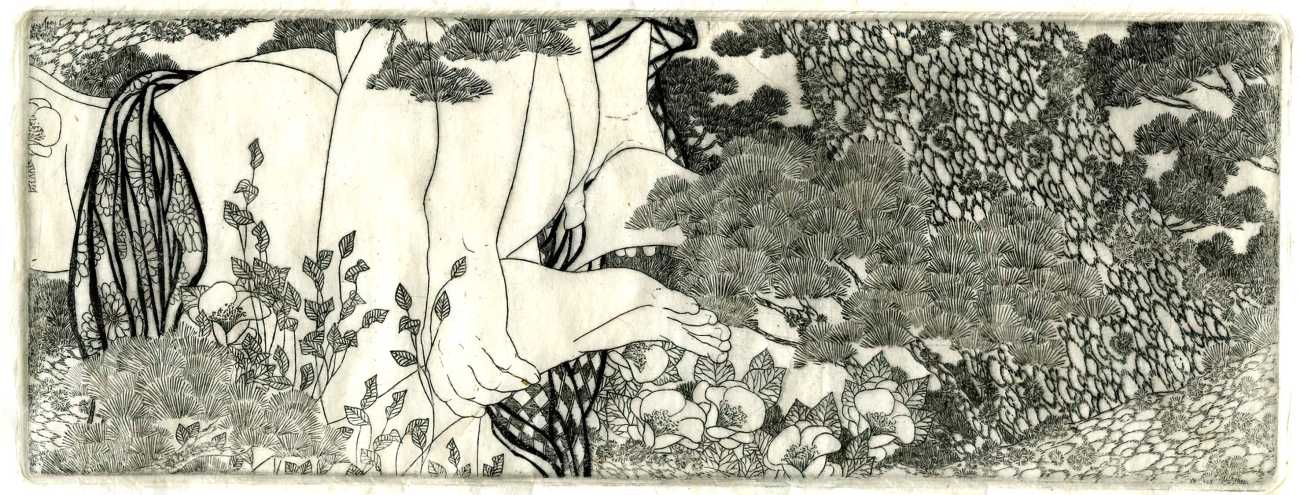
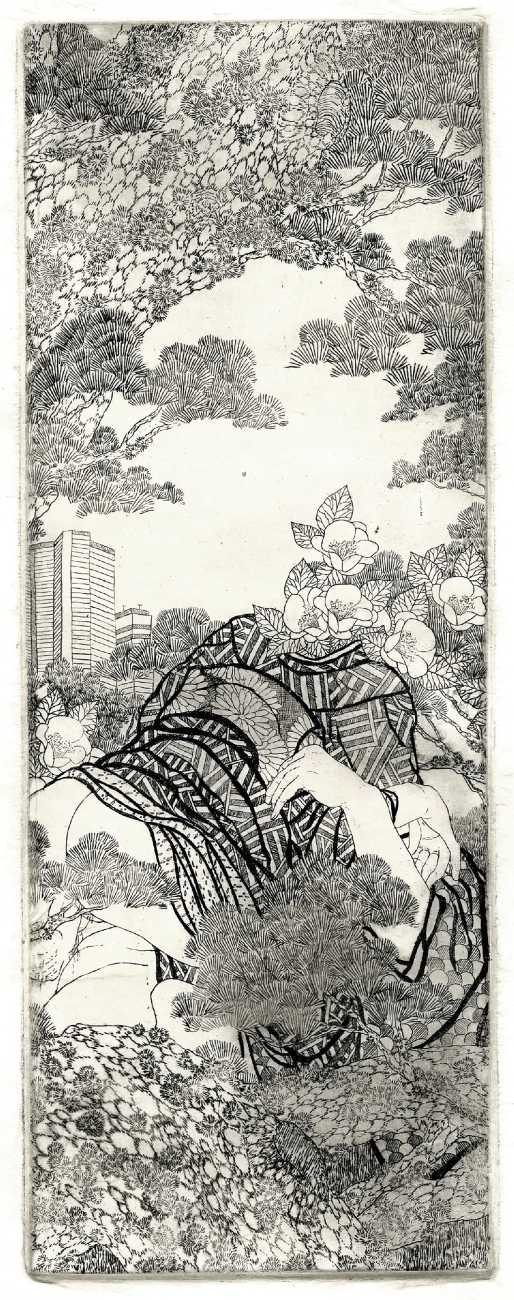
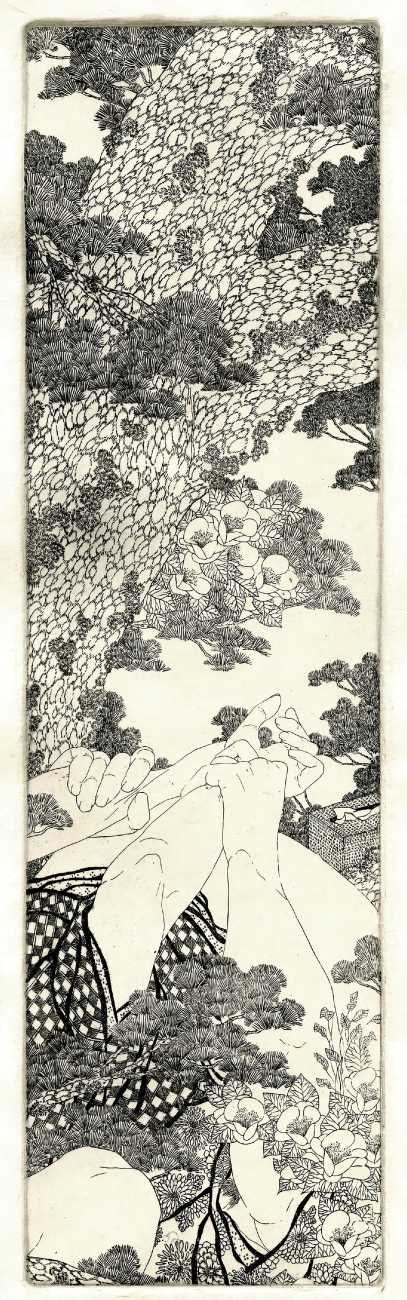
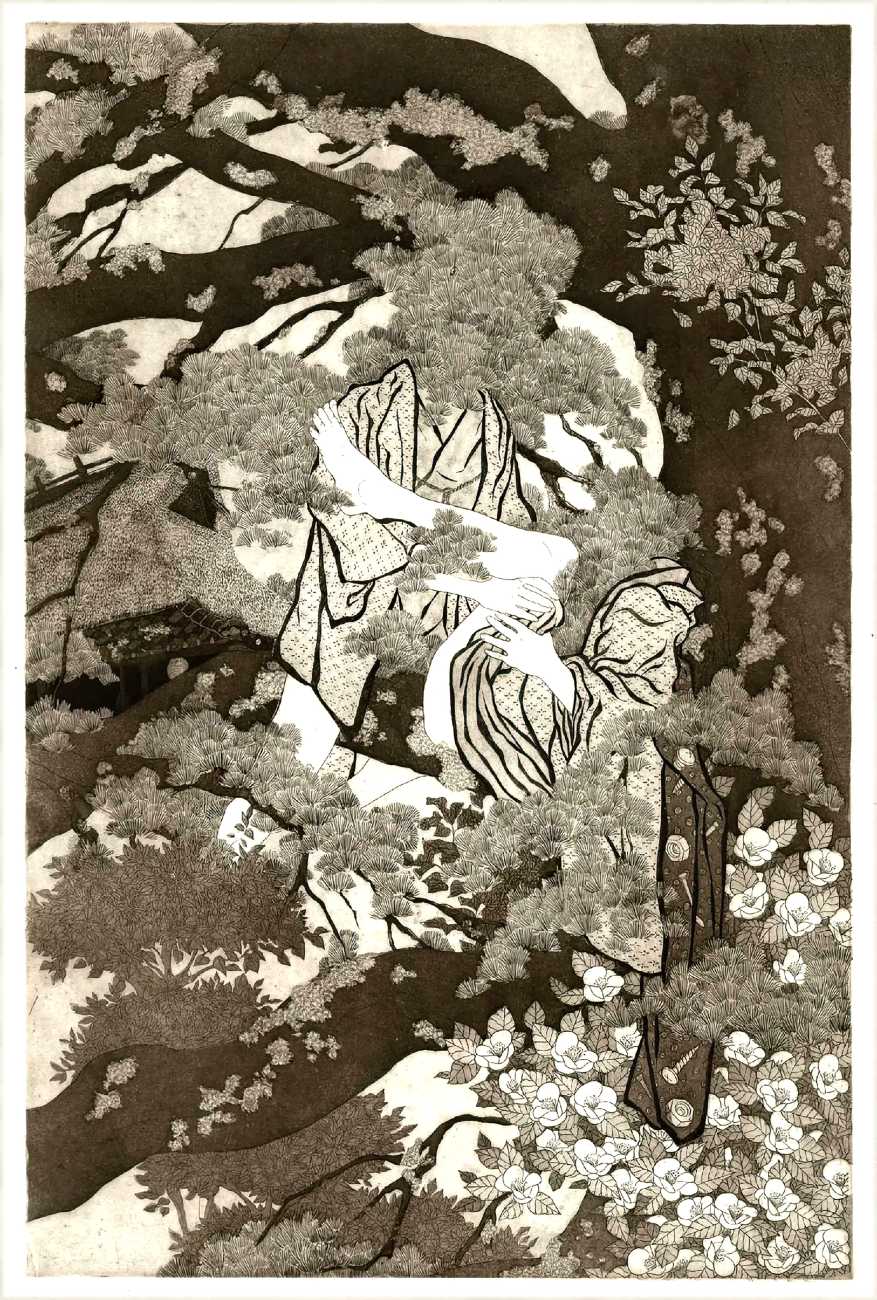
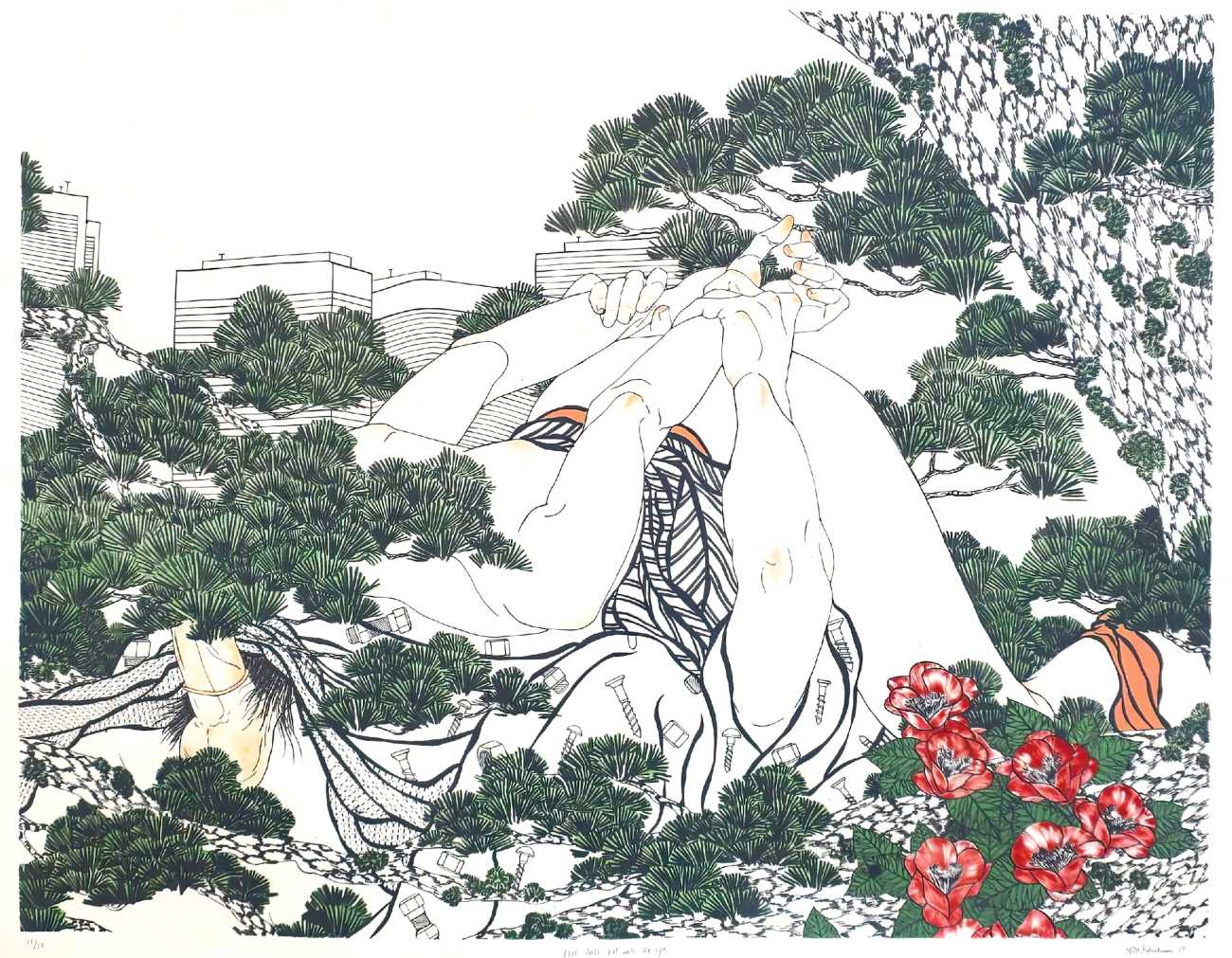
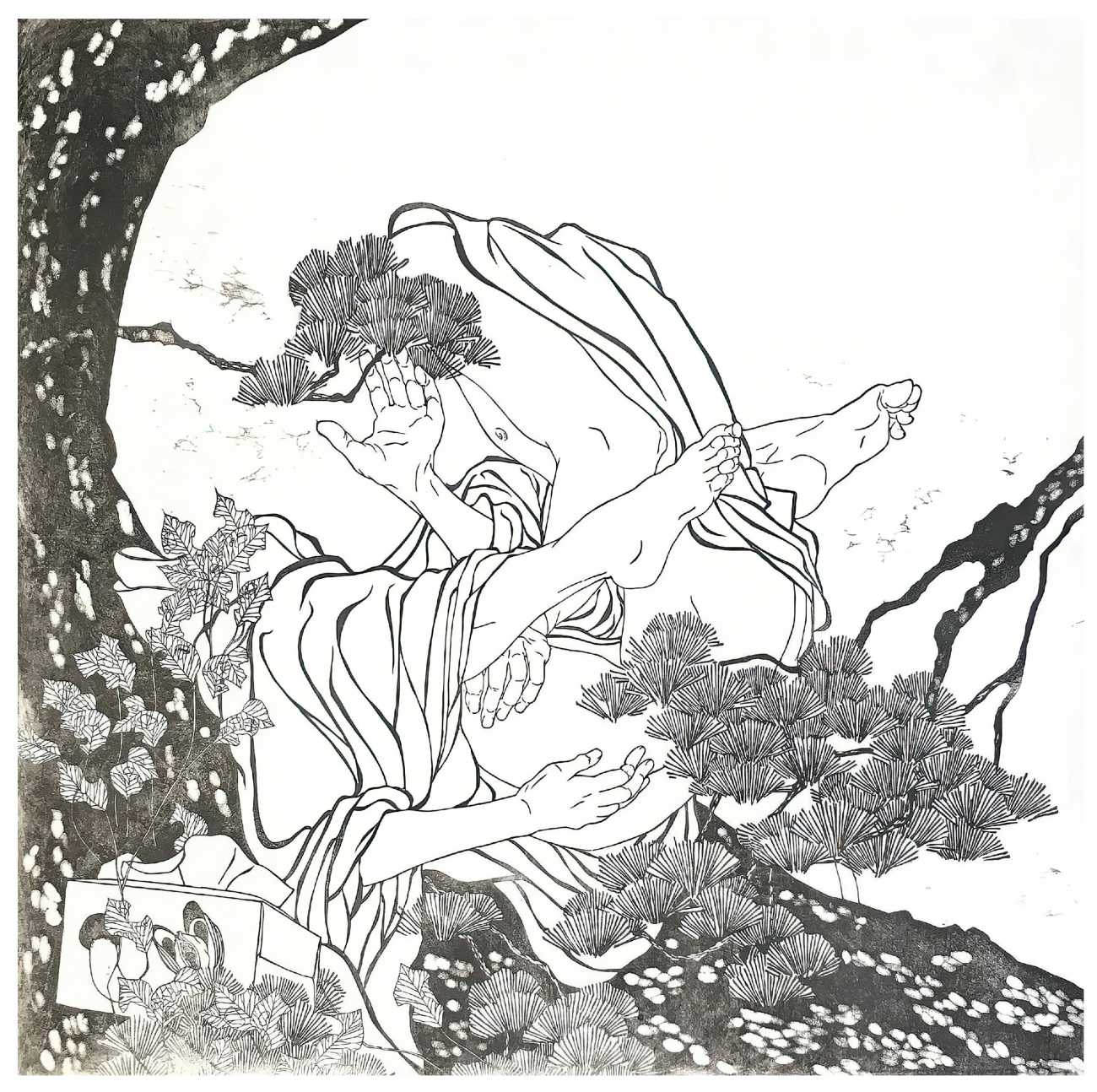
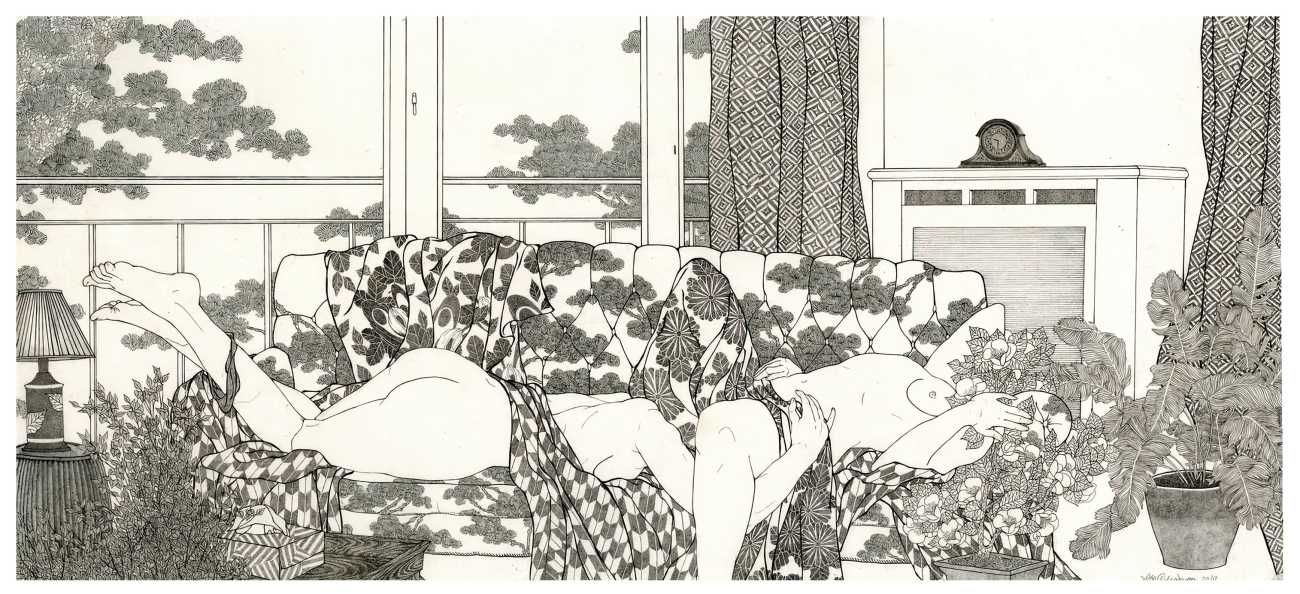
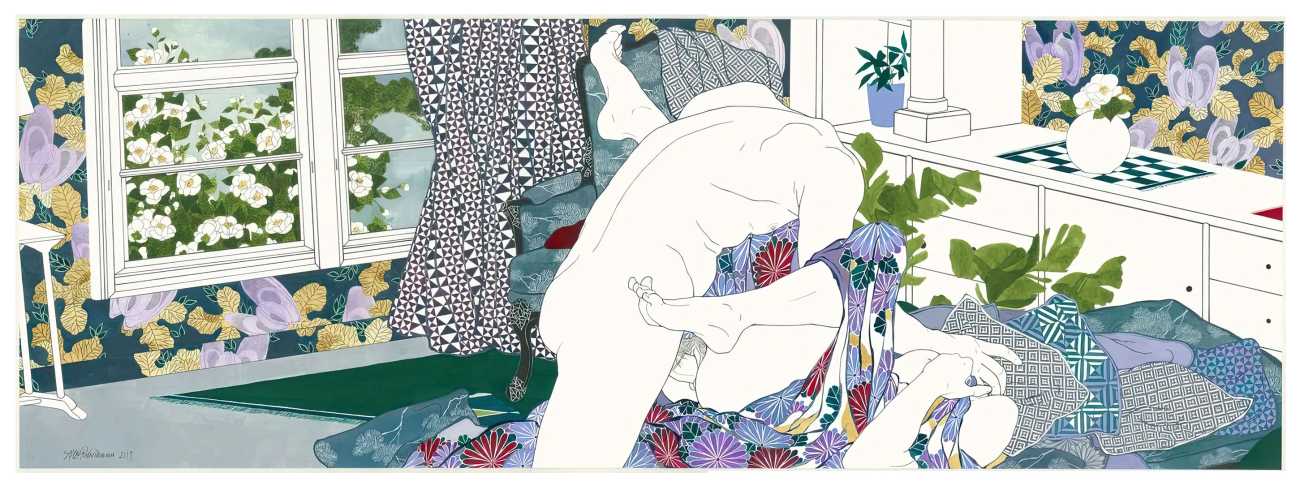
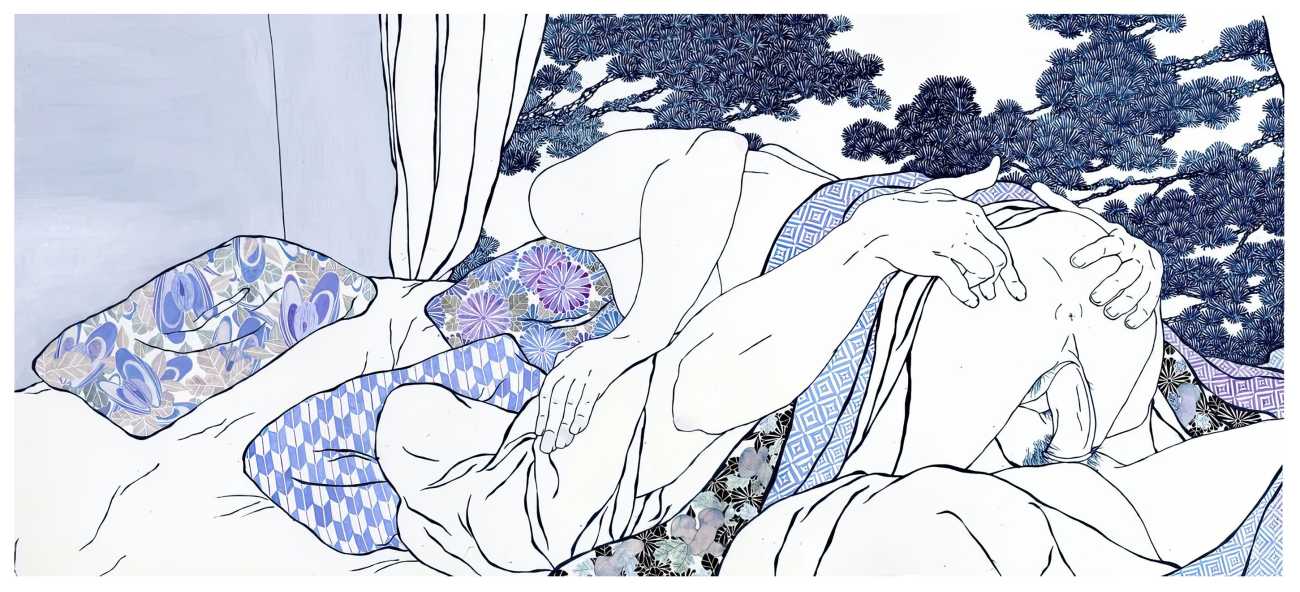
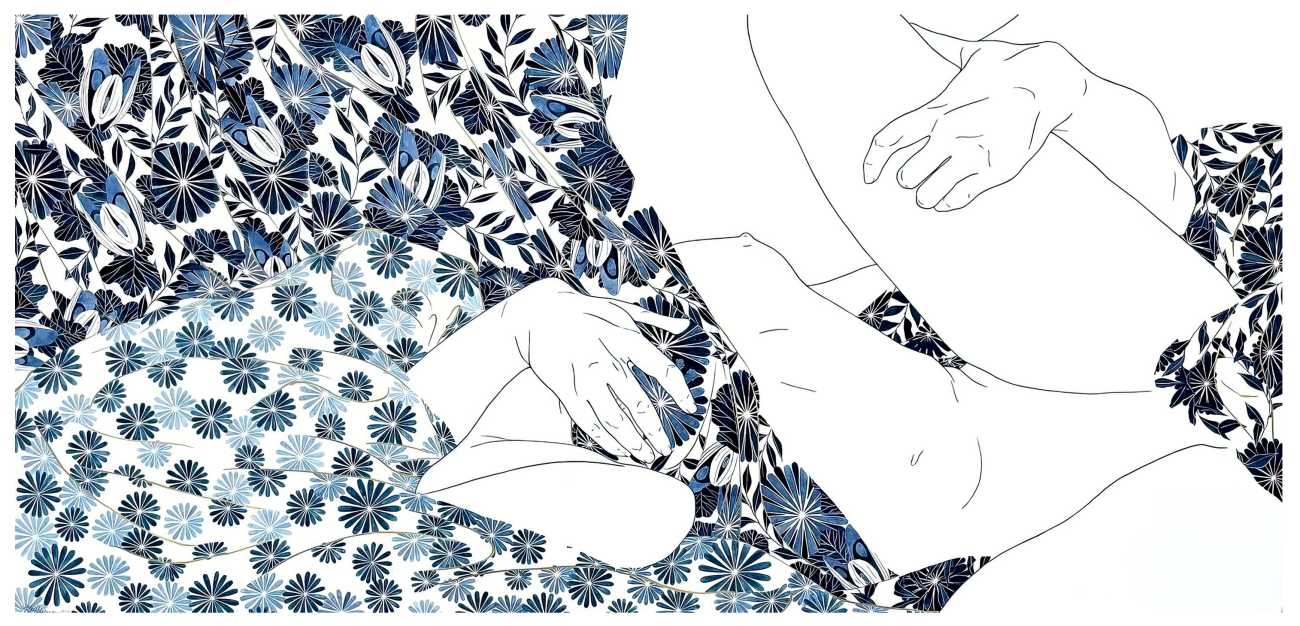
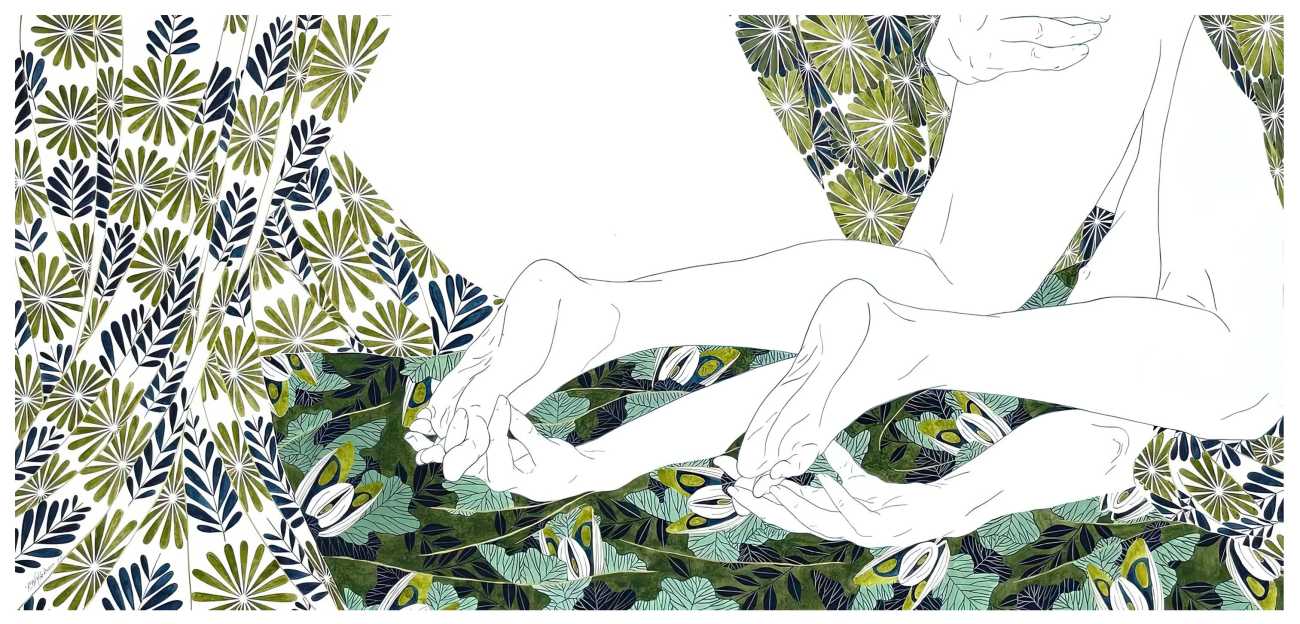
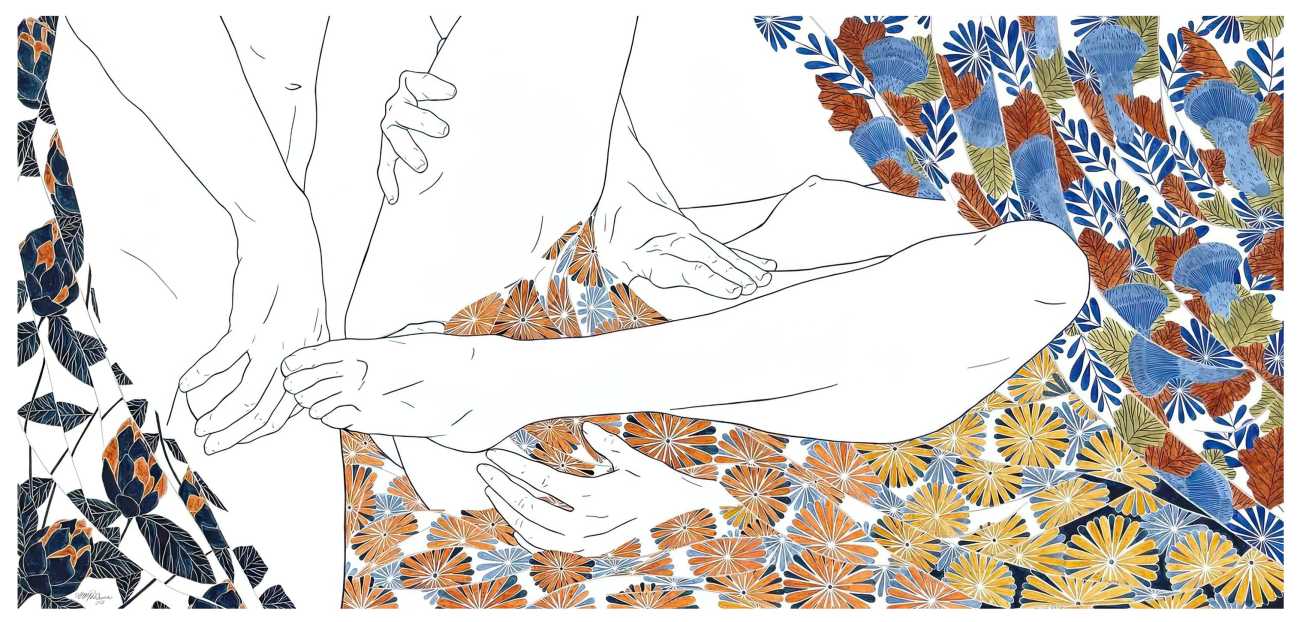
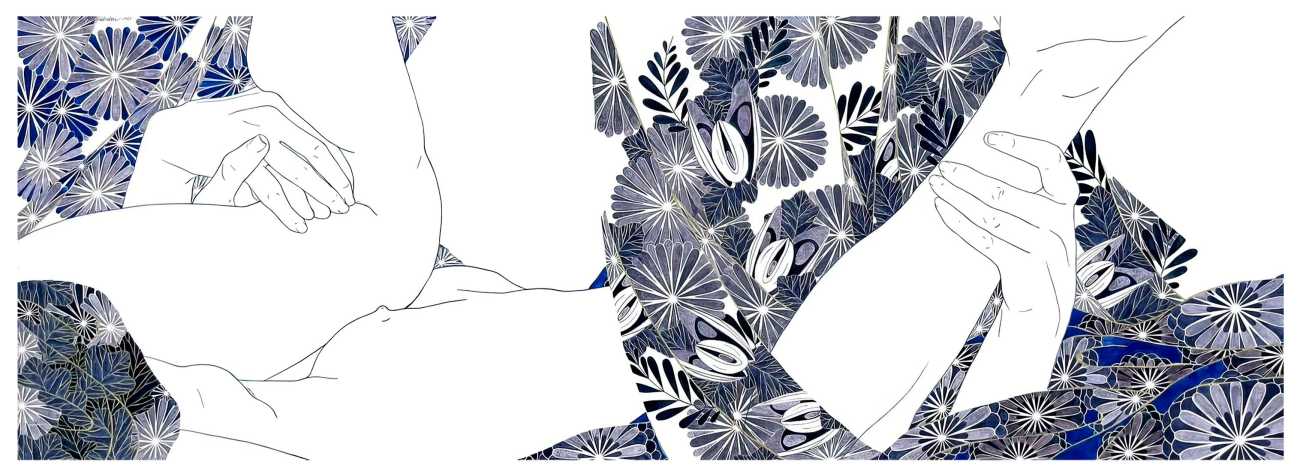
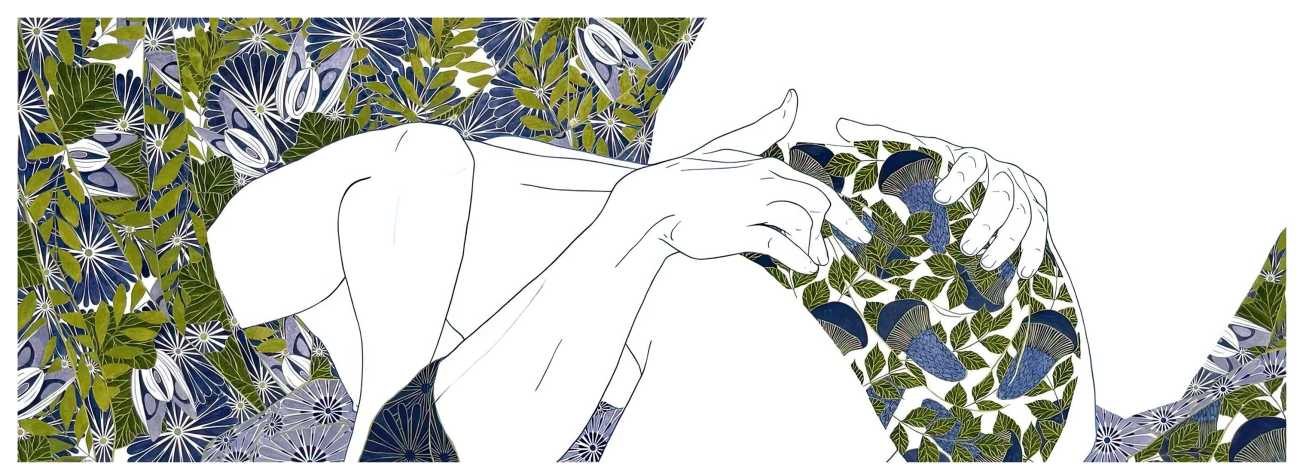
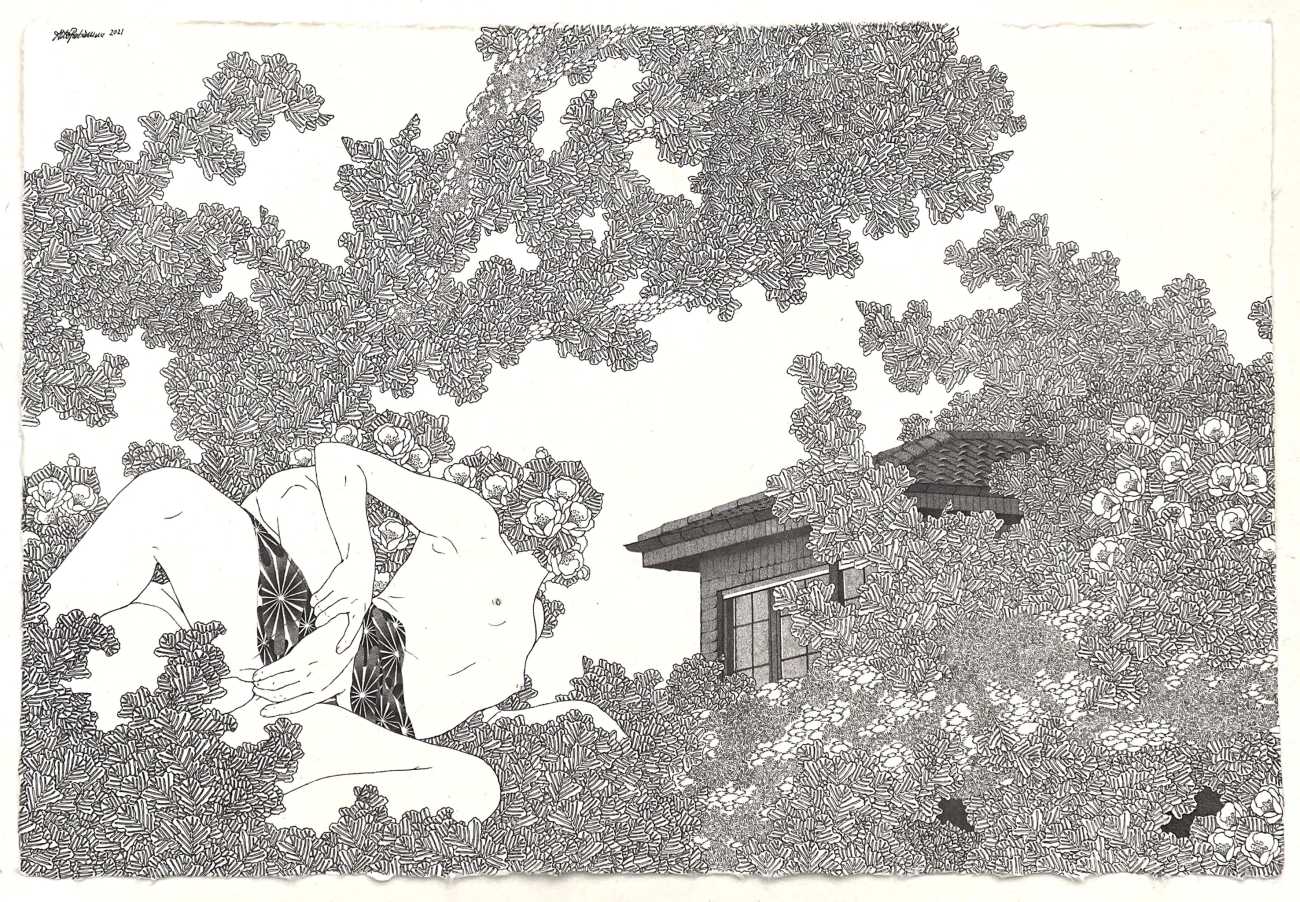
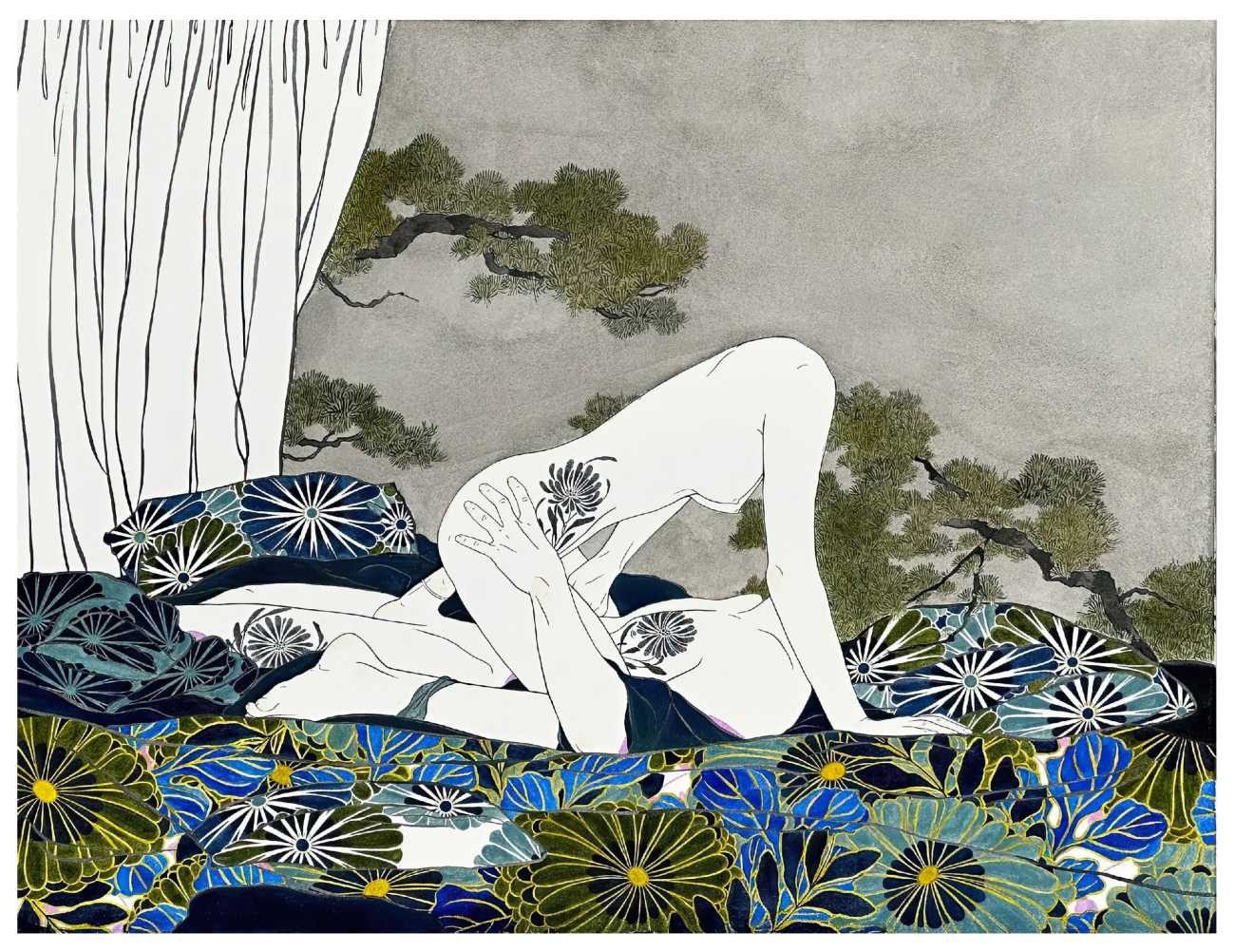
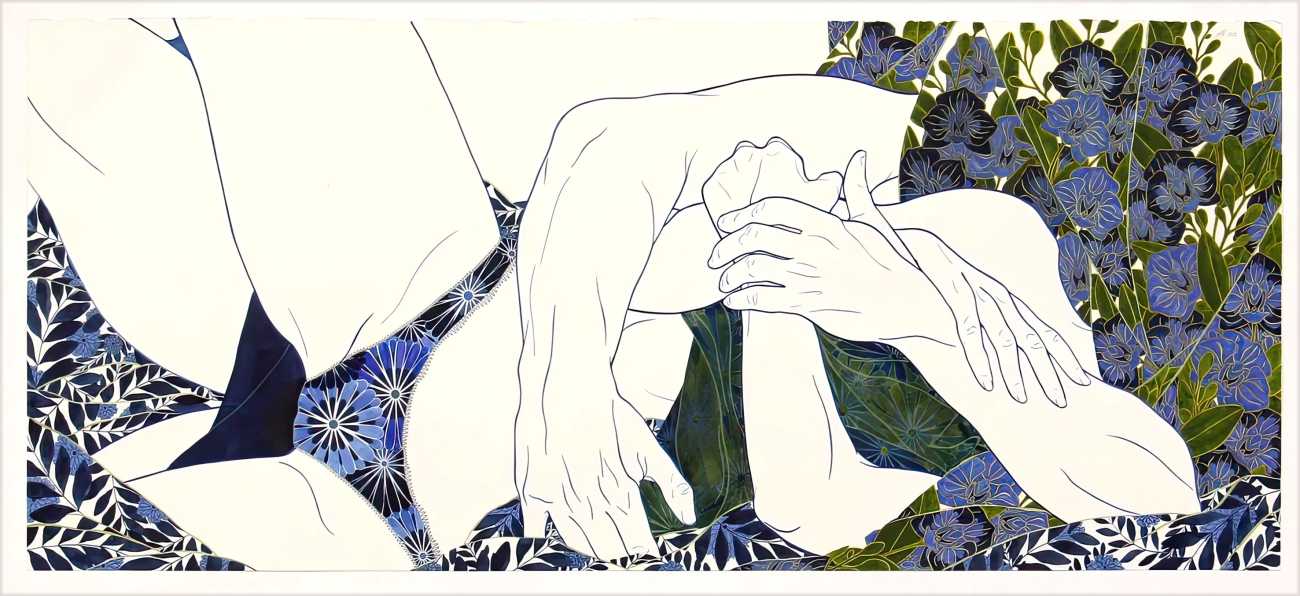
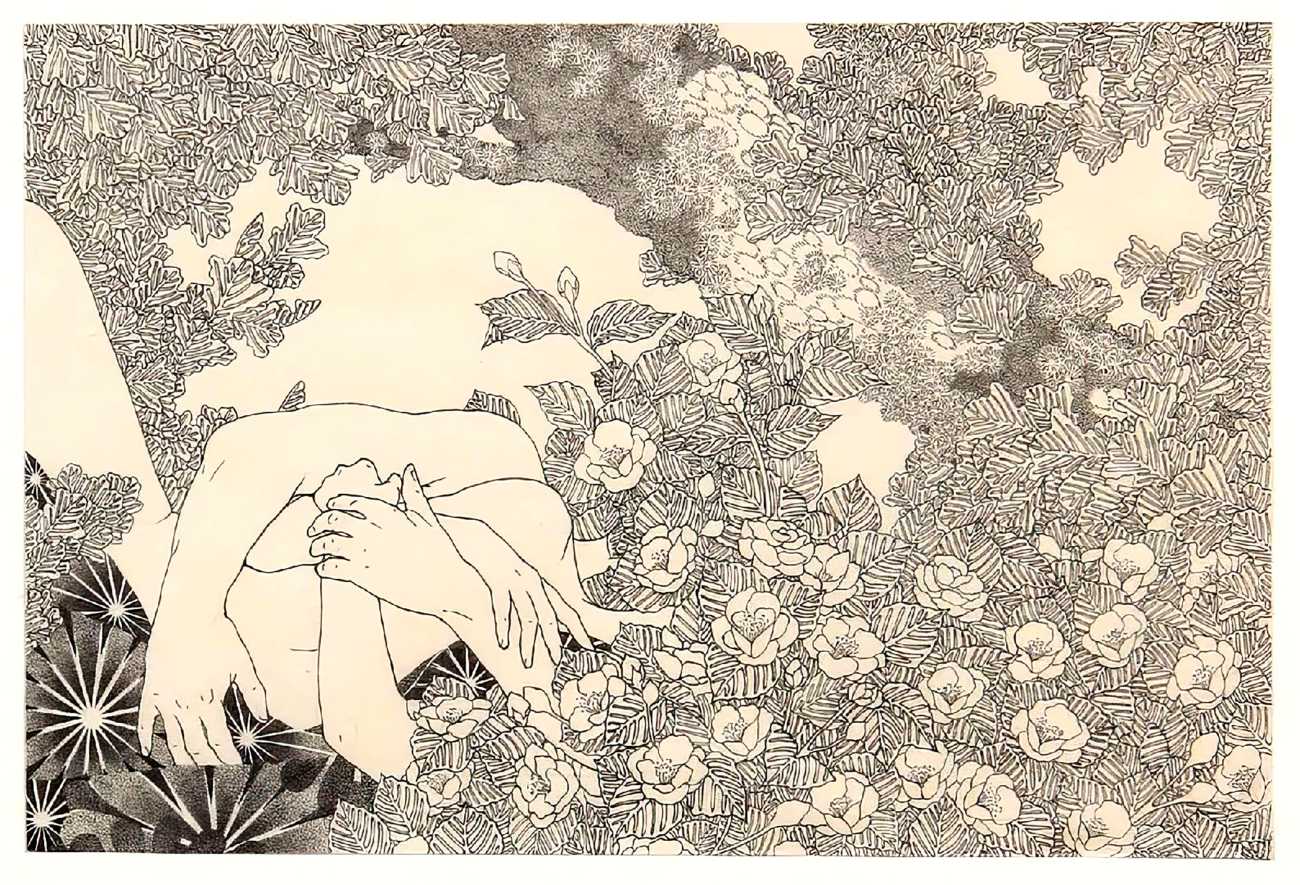
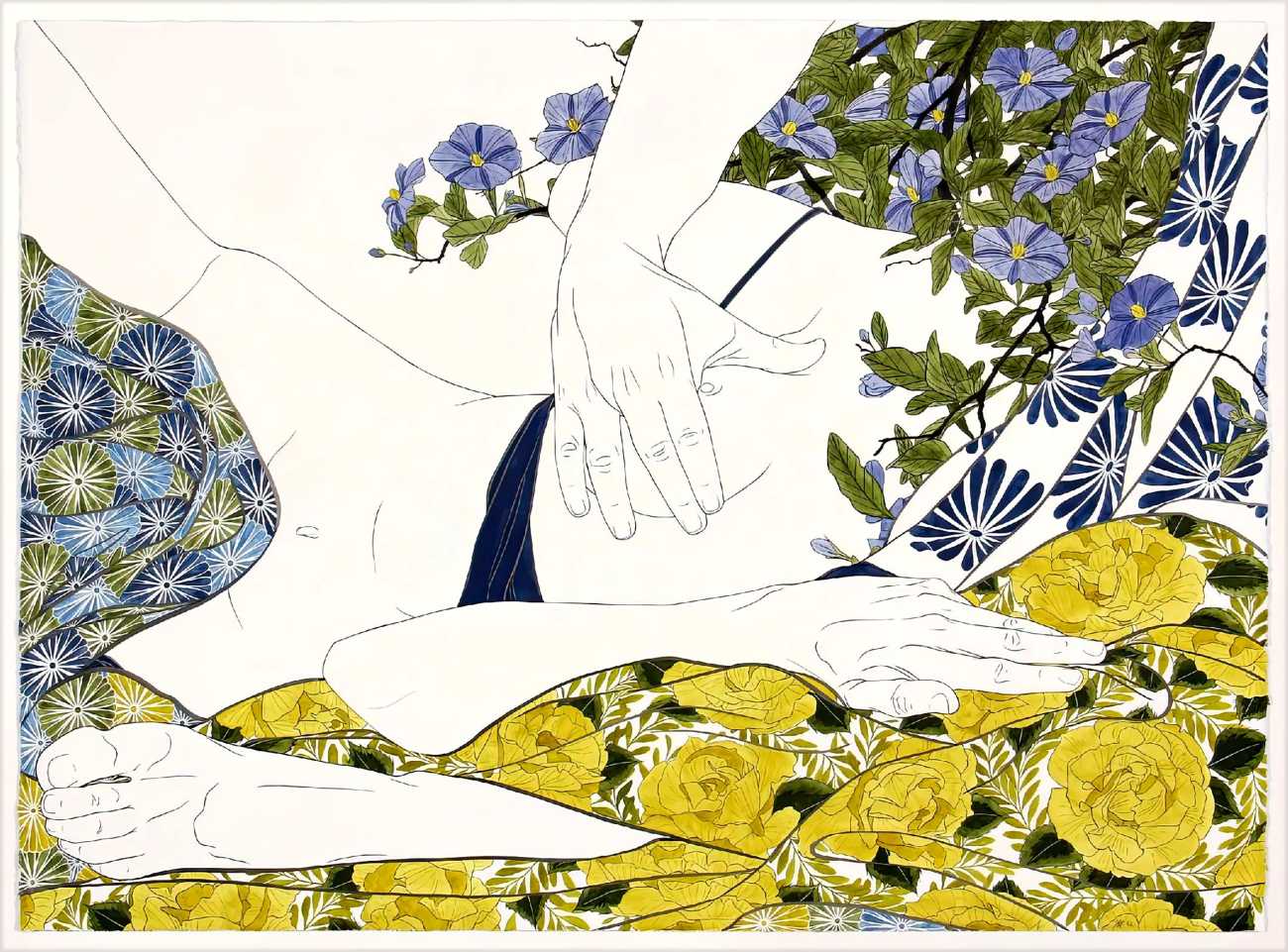
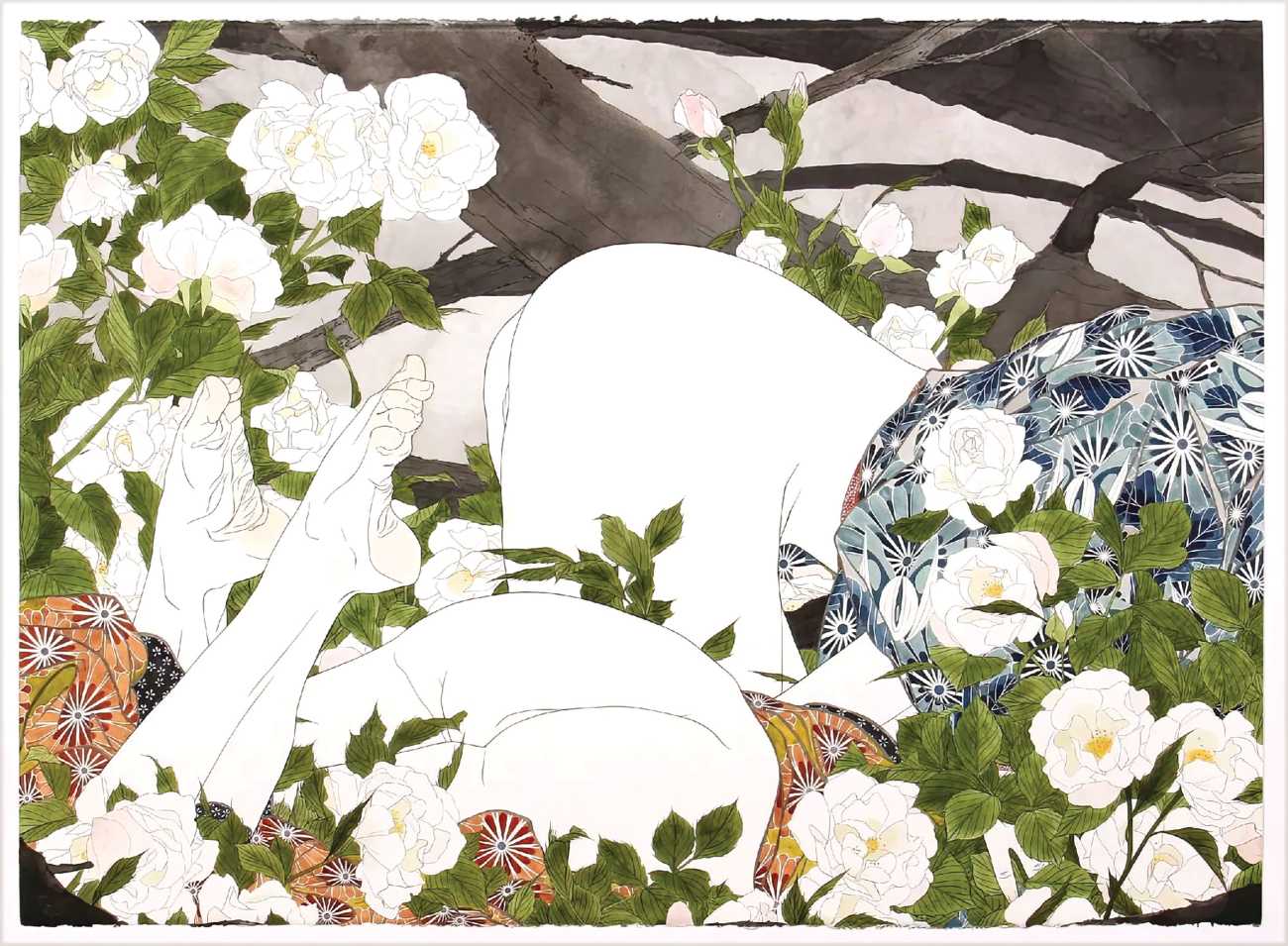
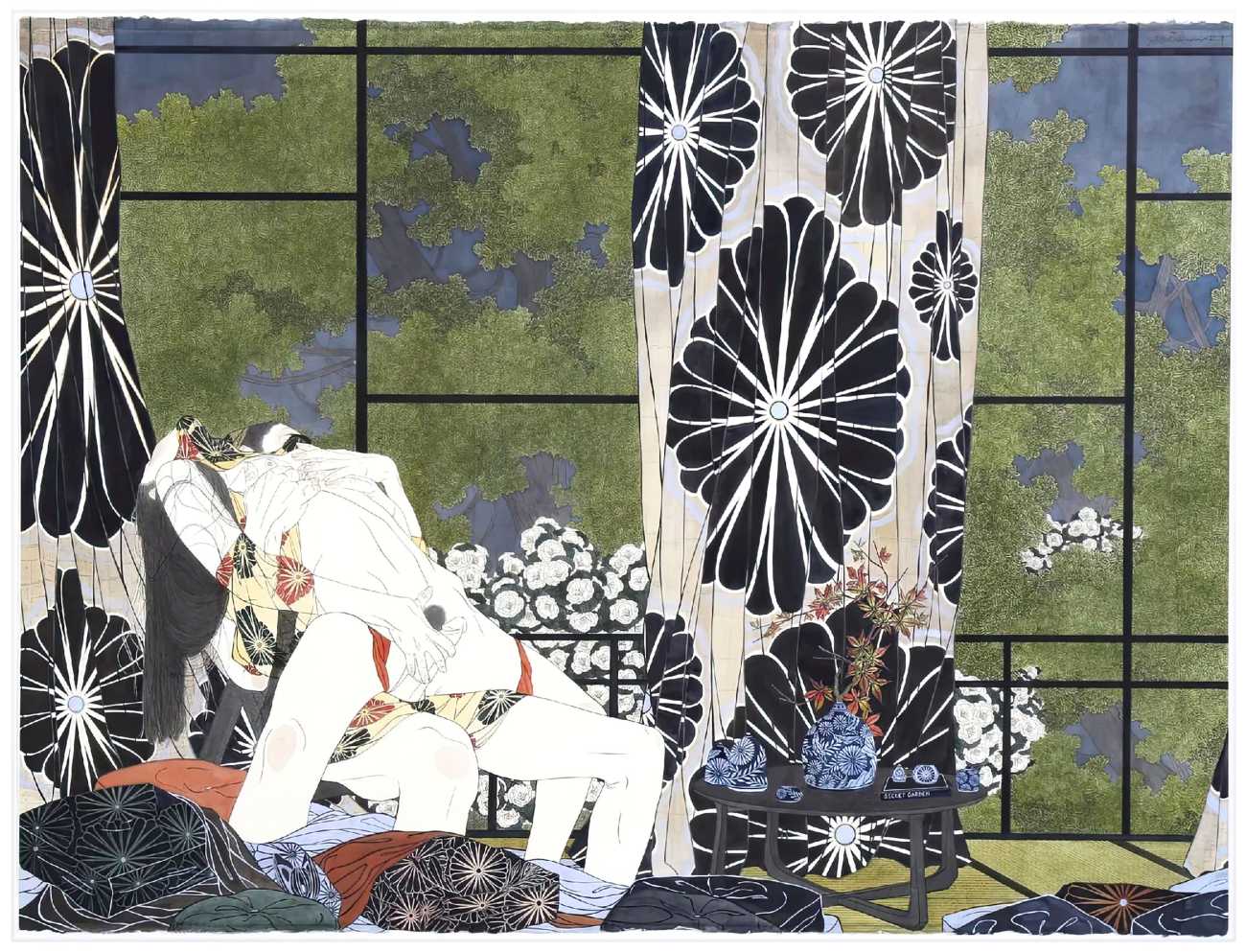
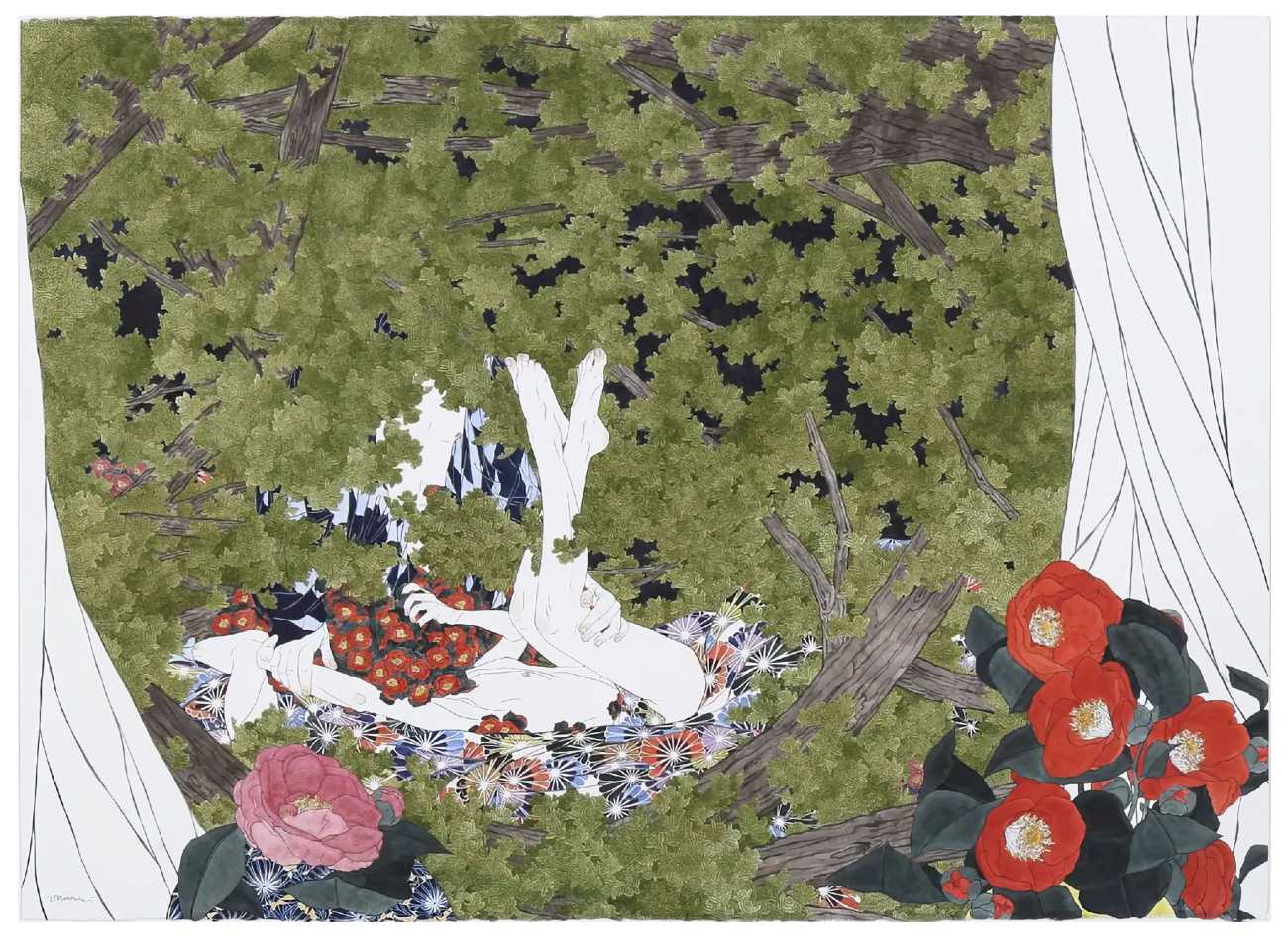
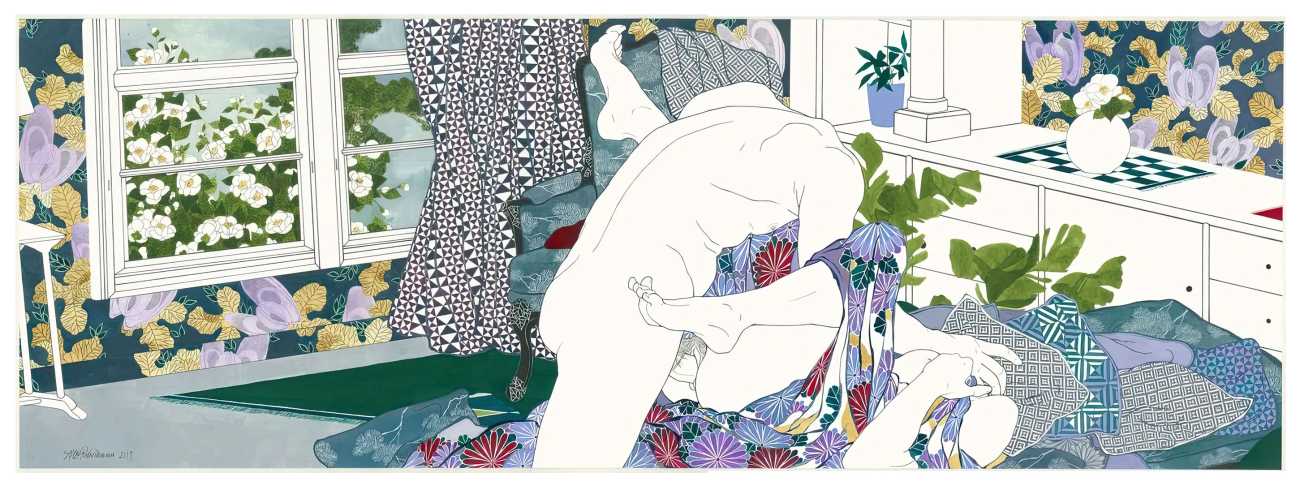
In 2015 Aiko Robinson created the eponymous Love is Blind series, which was exhibited at the Marueido Gallery in Akasaka, Tokyo, in 2018. We have used it here as an overall title for her shunga prints, nearly all of which feature her trademark headless – and therefore blind – figures.
We show her work here in chronological order, from her early 2014 monochrome woodblocks, through the black-and-coloured-ink Love is Blind series with evocative titles including ‘Like Diving for Pearls’ and ‘Like a Bud Glistening with Morning Dew’, to her colourful 2023 compositions ‘As Evening Draws On and I Gaze on Long Rain Falling’ and ‘Hidden from All but the Moon’.
In December 2018, to coincide with the Tokyo exhibition, Vice magazine interviewed Aiko Robinson; you can read the whole interview here, and we have reproduced the most interesting questions and answers below.
How did you first become interested in shunga?
What drew me into them was the fact that they were quite different to the erotica and pornography that we see today. I think the west probably romanticises the shunga prints quite a lot, but essentially what they’re all about is love and mutuality. It was also all about the craftsmanship; they’re very beautiful to look at. They often deal with humour as well. Another name for shunga prints is warai-e, which means ‘laughing pictures’. It had a lot of positivity around it, and the warai-e concept of making people laugh as opposed to it being purely for pleasure. It was all about having a little bit of a giggle over them as well. I thought I could bring back some of those ideas into contemporary society, because a lot of the time pornography can be quite offensive, especially to female viewers. I just feel like it has a slightly more negative connotation. It’s viewed as being a bit taboo, a bit sinful in this day and age. I wanted to bring back a more positive outlook on erotica, because I think sex is a wonderful thing.
When you say offensive, do you mean misogynistic?
Yeah, there are a lot of problems with pornography. There definitely is a lot out there that I feel is doing it right, but the stuff that is readily available to us online can be a little bit aggressive towards a sexual partner. Things that they convey seem to be a little bit unhealthy. I remember reading some text when I was doing really thorough research on this back in my honours year – it talked about how when you repress sexual desires from people, when you tell them it’s sinful and you tell them it’s taboo, and not to look at erotic material or to masturbate or whatever, it brings out a slightly creepier kind of desire. When you’re told not to do something it can come out in a very aggressive kind of way, and I feel like that’s what I’m seeing in a lot of contemporary pornography, whereas in the Japanese ukiyo-e, a style of painting and woodblock printmaking, in the Edo period from the seventeenth to the nineteenth century, people were very open, for both men and women. Their religion didn’t tell them that it was sinful to look at these things. It was viewed as something to celebrate.
You mentioned that the west tends to romanticise shunga, can you tell me what you mean by that?
Even though sex is a universal thing, what we view as erotic can be vastly different. So in the west, shunga was never seen as being like pornography because the way it was approached was very Japanese and the way it was crafted was very laborious. A lot of work went into it, a lot of creativity. So even historically I think it was hard to view it as pornography, it was often seen as a craft or an art. And now the west sees it as a form of high art. One of the things I’ve been really interested in about shunga is it’s actually seen as being a bit taboo in Japan now. Whereas it was something they celebrated in Japan back in the day, they now see it as something we should be ashamed of, and I think that notion comes from the fact that the Japanese understand that shunga was primarily used as pornography.
Why does shame around it exist in Japan?
In the Meiji era, with the introduction of western trade and Christianity into the culture, Japan started to view shunga as something taboo, and that sadly continues to this very day. Whereas in the west a lot of places have been exhibiting shunga, and a books about shunga will show them crystal clear, the Japanese have kept it a little bit secretive, and even if shunga is featured in textbooks it’s often censored.
What are the main differences between traditional shunga and the prints you create?
It’s hard to say what the differences are; it’s really important to me that it visibly references shunga prints because I want to talk about their idealised visions of pornography and bring that into contemporary society. But some of the ways I try to make it relevant to contemporary society is by bringing in modern visual elements, like sometimes there’ll be a little tissue box or some used tissues around the couple.
Can you tell me about the significance of leaving your figures without heads?
It was first a sort of tool to abstract the figures a little. I noticed by removing the heads it made the entire composition a lot harder to read. I want people to spend time with my work, and when the statement is a too bold I risk scaring my viewers away. By removing the heads I noticed that it made these abstract forms which people wouldn’t be able to figure out straight away, which meant they would look at my work a little longer, and only after a few seconds realise that it was erotic. Since then the headlessness has taken on new possibilities, and I use it as a way of creating humour in my work. My sense of humour is possibly a little bit dark and weird, but I often have couples engaging in oral sex, which is actually physically impossible for my figures, and I find that funny. I like the juxtaposition of these headless figures. I think the idea of headless people not being able to engage in oral sex, not being able to kiss, not being able to even have sexual fantasies for lack of a mind, yet still engaging in these sexual acts – it just seemed really bizarre and hilarious.

Do you think humour is lacking in contemporary erotica in a way it isn’t with traditional shunga?
Yeah, I think that the shunga of contemporary society is actually anime and manga, some of the erotic stuff. And those are quite hilarious sometimes, but in a cruder way. I think it’s possibly lacking, or maybe it’s just humour that I don’t get. By bringing humour into these works it makes them slightly easier to approach, and so I‘m really obsessed with juxtapositions. I like the idea of working with this supposedly challenging material but trying to make it approachable and easy to look at, and humour has been my way of doing that. I don’t really see that much in contemporary pornography, at least not in the stuff that’s really easily accessed online.
How does using contemporary porn as source material make your figures different from those in traditional shunga?
Shunga prints depicted their ideal, beautiful person of the time, which tended to be quite round and sort of shapeless. It’s often hard to tell whether the figure is female or male, just looking at the full figure of the two people involved. In the pornography I’m seeing, I think there is more definition between the two.
Traditional shunga was quite homoerotic, is that something you explore as well?
I have done a fair bit of homosexual works too, or ones where the genders of the couple are quite ambiguous. I think that’s also a really interesting topic. In the shunga of the Edo era, the reason why those homosexual works were quite common is because Tokyo was apparently two-thirds male. The whole idea of male homosexuality was quite common, and readily accepted by society. I’ve been trying to bring that into my work a little bit more.
Do you have a favourite work or artist?
I do love a lot of Utamaro’s prints and also Hokusai’s. I don’t know if you’re aware of The Dream of the Fisherman’s Wife – the one with the octopus – it’s pretty incredible. And then there’s another of Utamaro’s prints – you don’t see much, just see a couple kissing, but it’s from behind so you only see a little bit of the man’s eye and then you see just a tiny bit of the woman’s neck and a bit of her bottom. It’s enough; it conveys so much. I like that print a lot, just because eroticism can be conveyed just through a glimpse of a white neck. Sometimes you don’t need to be too bold.