
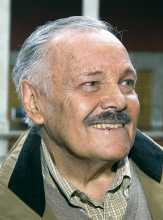
 José Luis Cuevas was born in Mexico City into a middle-class family, spending his earliest years above his grandfather’s pencil and paper factory, El Lápiz del Águila. He later recalled that growing up surrounded by paper, pencils and printing materials made drawing seem an entirely natural activity, while the crowded streets of the capital provided an endless source of characters to observe and sketch. His precocious talent was recognised early, winning a national children's drawing competition at the age of seven with a self-portrait entitled Niño Obrero (Working Boy).
Cuevas briefly attended the Escuela Nacional de Pintura, Escultura y Grabado La Esmeralda as a child, but his formal education was cut short when he contracted rheumatic fever when he was twelve. Confined to bed for almost two years, he immersed himself in reading and drawing, an enforced isolation that proved formative. During this period he continued his artistic education informally, studying engraving with the celebrated puppeteer and printmaker Lola Cueto at Mexico City College. Although he always acknowledged these influences, Cuevas remained essentially self-taught, developing his own highly individual graphic style outside conventional academic training.
As a teenager he rented a modest studio in central Mexico City rather than return to full-time education, supporting himself by illustrating books and newspapers. He also sought out subjects rarely considered suitable for fine art. Visits to hospitals, psychiatric institutions and the impoverished districts of the city exposed him to human suffering, loneliness and marginalisation, themes that would remain central throughout his career. Prostitutes, inmates, beggars and social outsiders became recurring figures in his drawings, rendered with psychological intensity rather than sentimentality.
During the 1950s Cuevas emerged as one of the leading figures of the ‘generación de la ruptura’, a group of younger artists who rejected the heroic nationalism of the great Mexican muralists. His outspoken criticism of official muralism, most famously in his essay La Cortina de Nopal (The Cactus Curtain), established him as one of Mexico's most controversial artistic voices. Rather than celebrating collective political ideals, Cuevas concentrated on the complexities, anxieties and contradictions of individual experience.
His personal life often attracted almost as much attention as his work. In 1961 he married Bertha Riestra, whom he had met while she was undertaking community service at the psychiatric hospital La Castañeda. Their marriage endured until her death in 2000 and provided a degree of stability during decades of international travel and growing fame. At the same time, Cuevas cultivated the image of the charismatic, provocative artist, openly encouraging stories of his numerous romantic affairs and delighting in challenging public expectations. This carefully maintained public persona mirrored the frank eroticism, vulnerability and psychological ambiguity that frequently appeared in his drawings.
In 1992 he realised a long-held ambition with the opening of the Museo José Luis Cuevas in the historic centre of Mexico City, where his own work was displayed alongside the international art collection he had assembled over many years. The museum later became home to the Sala Erótica, reflecting an aspect of his work that had always been present: a fascination with sexuality as an expression of both desire and human frailty. By the time of his death in 2017, Cuevas had established himself as one of the defining figures of modern Mexican art, celebrated as much for his uncompromising independence as for the expressive power of his draughtsmanship.
Similar artists
Hans Bellmer – German-French surrealist, an important influence.
Jean Dubuffet – French painter of raw, unidealised art brut figuration.
George Grosz – German expressionist of grotesque, socially satirical figuration.
Roberto Matta – Chilean surrealist of anxious, distorted bodies.
Pablo Picasso – Spanish painter, a direct homage subject in Cuevas's self-portraits.
Egon Schiele – Austrian expressionist of raw, psychologically intense figure drawing.
Example illustration


