
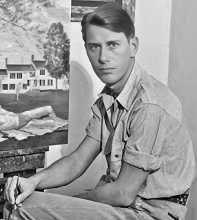
 Paul Cadmus grew up in New York City in a family of artists – his father worked as a commercial illustrator and his mother illustrated children’s books. They both encouraged his artistic ambitions, so Paul was immersed in drawing from an early age. At the age of fifteen he left school to study at the National Academy of Design, where he received a rigorous academic training that fostered the precise draughtsmanship for which he would become renowned. Although modernism dominated much of the art world during his lifetime, Cadmus remained committed to figurative painting and the careful study of anatomy, finding inspiration in Italian renaissance painters such as Andrea Mantegna and Luca Signorelli, whose muscular figures and sculptural forms profoundly shaped his own artistic vision.
A formative journey through Europe in the early 1930s, undertaken with fellow artist Jared French, deepened his appreciation of renaissance art and reinforced his commitment to the carefully observed human figure. After spending time in France, Spain and Mallorca, he returned to the United States with a mature artistic vision that combined classical technique with an uncompromisingly modern sensibility. Returning to the United States during the Depression, Cadmus found employment through the federal New Deal art programmes, but it was controversy that first brought him widespread public attention. His 1934 painting The Fleet's In!, with its boisterous sailors, suggestive humour and unmistakable homoerotic undertones, provoked official outrage and was removed from exhibition by the United States Navy. Far from damaging his career, the incident established Cadmus as an artist unafraid to challenge accepted social conventions.
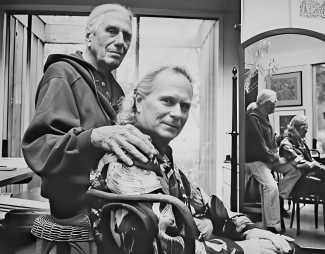
Cadmus lived openly as a gay man during an era when such openness carried considerable personal and professional risks. His relationships with other artists, writers and dancers placed him at the heart of an influential cultural circle that included Jared French, George Tooker, Christopher Isherwood, W.H. Auden and George Platt Lynes. From 1964 until his death he shared his life with Jon Anderson, who became both his partner and the model for many of his later works. Their thirty-five-year relationship provided a lasting source of companionship and creative inspiration.
Although critical opinion sometimes fluctuated during the ascendancy of abstract art, Cadmus never abandoned his commitment to figurative realism. Today his work is represented in many of America's leading museums, and he is widely regarded as one of the country’s most accomplished figurative artists. His mastery of painting and drawing, together with his frank celebration of the male body, has secured his place as one of the most important queer artists of the twentieth century.
Similar artists
Patrick Angus – American painter of gay bars and porn theatres in the AIDS era.
Peter Flinsch – German-Canadian illustrator of mid-century homoerotic subjects.
Duncan Grant – British Bloomsbury painter of male homoerotic subjects.
Michael Kirwan – American gay illustrator of contemporary erotic subjects.
Touko Laaksonen – ‘Tom of Finland’, Finnish illustrator of explicit muscular gay-fetish men.
Keith Vaughan – British postwar painter of the male naked body and mythological subjects.
Example illustration


